On April 10th, the 2026 Global Sumud Flotilla set sail for Gaza in the latest attempt to break Israel’s illegal naval blockade. Among the boats was the Ajjur, aboard which Richard Andersen sailed. The flotilla sailed for five weeks towards Gaza, but on 18 May, the Ajjur, among many other boats, was intercepted and its crew kidnapped by Israel. Richard was among those who were imprisoned and tortured for days.
Here, we’re sharing one narrative to come from this: Rich’ard’s experience, told through his journal-style messages to loved ones and fellow activists in a group chat. In Rich’ard’s words, we hear what it’s like to sail with the Sumud Flotialla: the frustrations of daily life at sea and of geopolitical obstacles, the moments of shared humanity. And also we’re sharing an essential part of the journey for Richard: his messages with Alaa, a Palestinian living in Gaza who started corresponding with the Ajjur. The two men formed a bond of reciprocal solidarity, sustaining one another’s faith through experiences of inhumane horror.
Alaa was writing using online tools and translators in order to reach Richard; despite this necessary technological intervention, their correspondence remains raw, sometimes deeply painful, always heartfelt. The connection between these two people, and the wider reciprocal reaching for connection between Gaza and the flotillas, are a testament to the profound world-building and wall-breaking potential of solidarity and shared commitment to a liberated Palestine.
Setting sail: ‘we start by decolonising our very selves
From Richard, April 24, 2026:
Dear friends,
I am off again, but this time not on my boat Cecilia but on the Ajju, a 40 foot fiberglass sloop named after one of the many Palestinian villages cleared by the Israeli army in 1948.
I am sailing with the Global Sumud Flotilla to Gaza, a civil society humanitarian mission established to break the illegal Israeli siege and deliver much needed aid to the Palestinian population in Gaza.
The first attempt at a civilian mobilisation to reach Gaza was in 2008 and there have been many since. Each met with heavy handed violence from Israeli soldiers.
We sail because we must, because we can no longer bear to watch a live streamed genocide happen in front of our eyes.
We carry aid in the faint hope that it will reach Gazan shores: the fourth Geneva convention explicitly mandates that parties to a conflict allow free passage of humanitarian aid, including food, medical supplies, and relief for civilians, while ensuring the safety of personnel. But we fully expect the Israeli military to brutally and illegally shut down the operation, as they have on every previous mission.
In the spirit of every non violent civil rights movement before us we lay our bodies on the line again and again to expose the brutality of the oppressive apartheid state of Israel.
After this message I will send my phone back to the UK. I have a disposable phone which I will use to send updates along the way.
We live in dangerous times. The far right is on the rise everywhere. Human Rights are being blatantly ignored by all our governments. The masks are off and the Epstein class are acting with impunity.
We sail to say ‘enough is enough’. We put our bodies in direct opposition to the military industrial complex. We will soon have nothing left to lose if the death cult of neo liberal capitalism is allowed to kill the entire planet.
I’ll sign off with the words of Aboriginal Australian activist, artist, and academic Lilla Watson in her 1985 speech to the United Nations Decade for Women Conference in Nairobi:
“If you have come here to help me, you are wasting your time. But if you have come because your liberation is bound up with mine, then let us work together.”
More soon (hopefully).
With love!
Xxx
From Richard April 29, 2026:
Swallows have started alighting on our boats as we draw a line through the Mediterranean with our collective wakes. These winged migrants with no sense of borders see an opportunity to rest a while on their way to more northern climes for the summer. They speak of a natural decolonisation of the Mediterranean, that has become the watery grave of so many, due to our inhumane drawing of lines to demarcate ‘us’, ‘not us’.
We left port in Augusta, Sicily, amid fanfares and shouts of ‘Free Palestine’ and ‘Fair Winds’. Nearly 60 boats have been stocked with food, fuel and humanitarian aid. Engines fixed, rigging repaired, and a deeply impressive training regime to get every participant up to speed on the political history of Palestine, how to conduct non-violent action at sea, and what to expect when encountering Israeli occupying forces. It’s been a sobering few days.
What strikes me the most is how ambitious this civil society project is. Not just in scope but in scale. We’re sailing to Gaza with a solid framework in our backs. The technical infrastructure is exceptional, both on land and at sea. Whatever the outcome of the mission, it is providing serious training in civil organising. The top tier of the Global Sumud Flotilla is held predominantly by female comrades and people from the global south and the Palestinian diaspora. Nearly 1,000 people have been fed, housed, trained and provided with functional and safe boats.
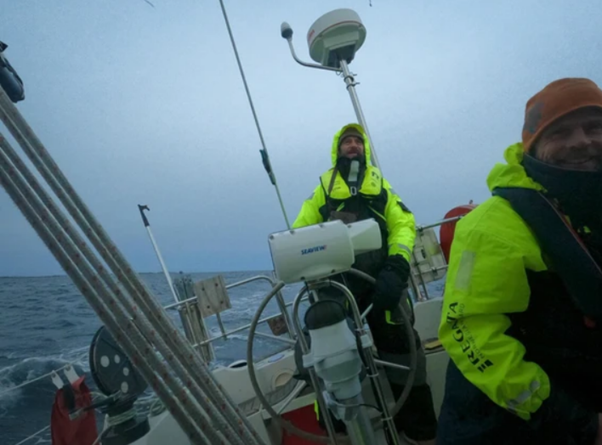
Three days in and we’re getting used to the routines at sea, the online morning meetings, keeping our pod formations in the wider fleet, sailing when there’s wind, motoring when there isn’t. As we sail in formation, a swelling wave of boats, bigger than any previous civil society fleet to sail on Palestine, we are carrying more than aid. This unbroken line of sails and lights across the horizon is carrying hopes and dreams of a better world. More than 100 nationalities of different colours and cultures and genders and languages are daring to imagine a world where our boats actually make their destination. A world where that destination is no longer ravaged by the pain inflicted by the world’s most advanced military on an indigenous population buried under a pile of rubble.
We are sailing with a message of decolonisation, not just for the Middle East, but for the Mediterranean Sea that connects us with the global south. We carry a hope of reckoning with our western colonial past, and of a decolonisation of our very imaginations.
Francesca Albanese criticised the Flotilla for being performative and symbolic. And in a certain sense she’s right: it very much is performative and symbolic, but I don’t see why performance and symbol shouldn’t be part of a wider global strategy to counter state terrorism. We peacefully assert our right to imagine something different, something better.
On the Ajjur, half the crew are Irish. There is a strong thread connecting the Irish and Palestinian resistance against British oppression. During our first evening of sharing songs I blurted out a song lyric by offering the line: “does anyone know ‘A Place Called England’? Without missing a beat Louise from Sligo dryly replied “I’m familiar with the place, yes…” I was vindicated with nods and appreciation after singing it through, though. Maggie Holland’s lyrics offer hopes of a decolonised England. A place rooted in its connection to earth and ancestors in geological time. This is where we need to start, by decolonising our very selves.
The Palestinian relationship to land is reflected in their traditional ‘keffyieh’. A garment of the fellahin, the Palestinian peasant farmers, it has become a symbol of solidarity across the world. The fishnet pattern represents the relationship to the Mediterranean Sea, to fishing as livelihood and trade. The bold intersecting lines represent trade routes, the movement of goods and people across the land. Some bear olive leaf patterns, representing the agricultural roots of Palestinian village life. The black and white contrast holds the tension between loss and persistence, between mourning and defiance.
A deep relationship to land and sea means believing ourselves part of a bigger whole, something more important than us as individuals. Part of our colonised mindset tells us that we are too important to sacrifice ourselves for any cause. But what greater potentials do we unlock if everyone sees themselves as part of a larger social organism?
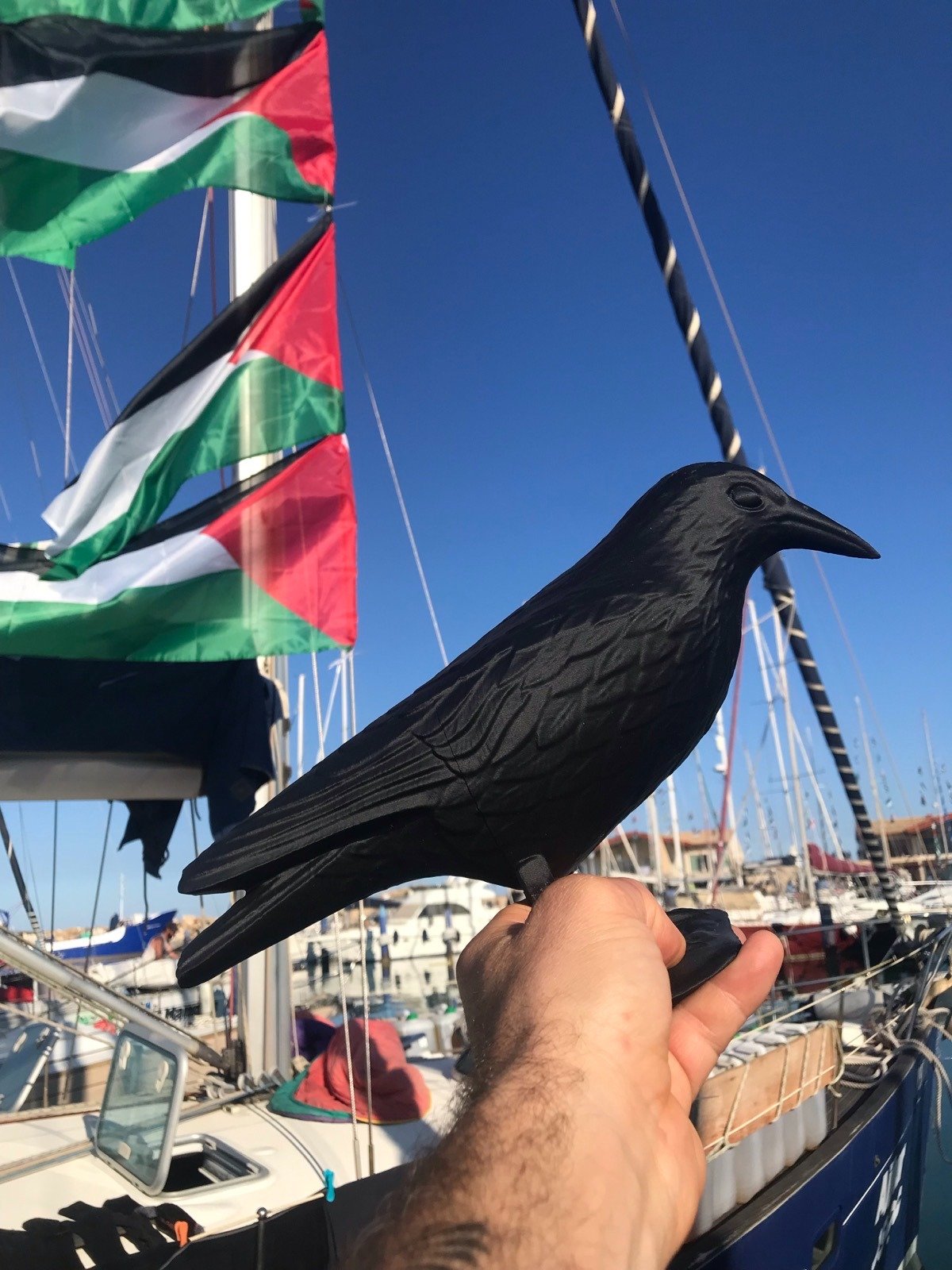
I hadn’t planned to be here. 48 hours before getting on a plane to Sicily to join the flotilla I thought I was going to be going in the opposite direction, to a memorial birthday commemoration for a dearly beloved comrade who passed away all too soon. Our dear beloved Jamie left a hole in the fabric of space-time no one person could ever fill. But the love and care and thoughtfulness he lived by, the example he set and the light he gave is still here. He’s here on the boat with us now, in the form of a crow figurehead, sitting atop the mast, looking down with a sly, knowing grin. Asking “when did ‘we’ become a possible pronoun?”
In Palestine they know sacrifice all too well. In sharing songs of longing and grief, our Palestinian comrades have sung the songs of mothers waiting for their sons to return from prison. Sometimes they do, often they don’t. The songs are part of a living tradition of music stretching back millennia, and still adapting to the present realities on the ground.
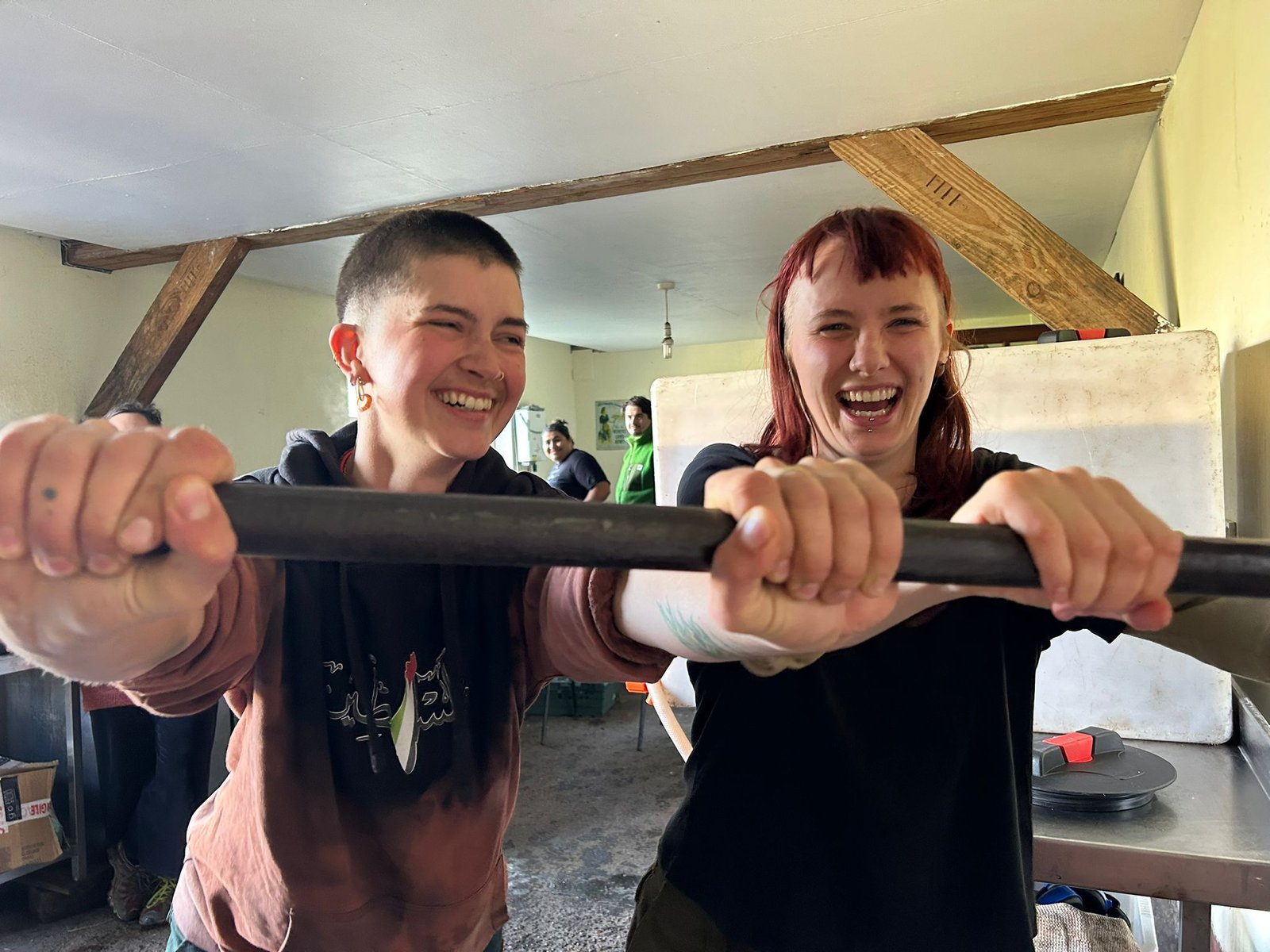
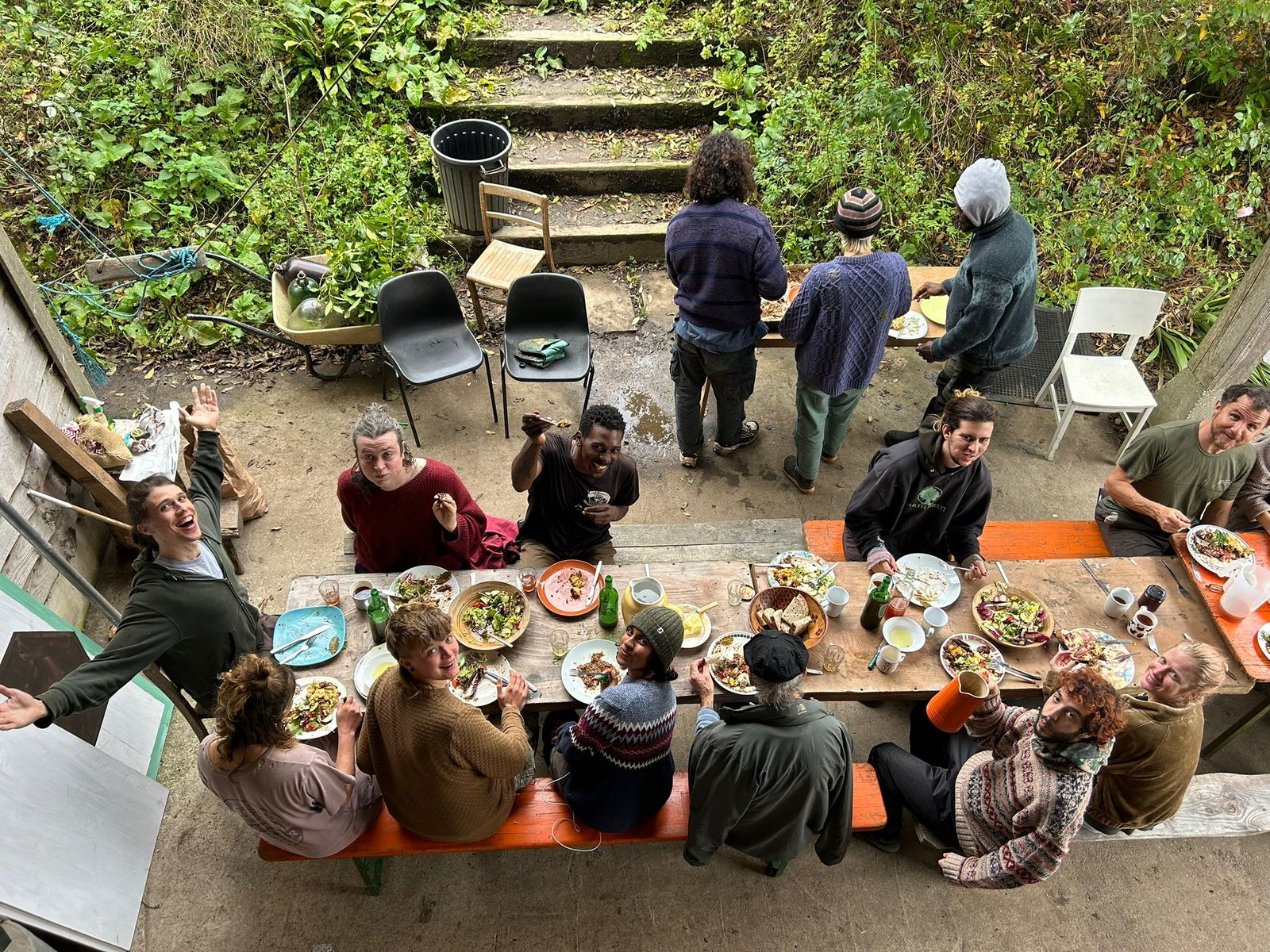
So onwards we sail, as a sum greater than all of us individually. We sail with joy and hope in our hearts, to counter the grief held by and for our comrades from the Palestinian diaspora and in the occupied territories and the apartheid state. We sing songs as we sail, we recite poetry and play tunes and share stories of land and ancestry. We cook and clean for each other. We meet the monotony of night watches and an endless expanse of blue, by offering each other collective care and believing in something better than our political leaders are willing to offer.
More soon (hopefully)
With love,
Us
Xxx
The first interception
From Richard April 29,2026
22:17 BST
If anyone is awake we are being intercepted by unmarked military vessels. Please forward to any channels available. Xx
From Richard April 29, 2026
22:50 BST
The Ajjur is still underway towards Crete in calm waters running by engine with most of the fleet still intact by what we can tell from the nav software.
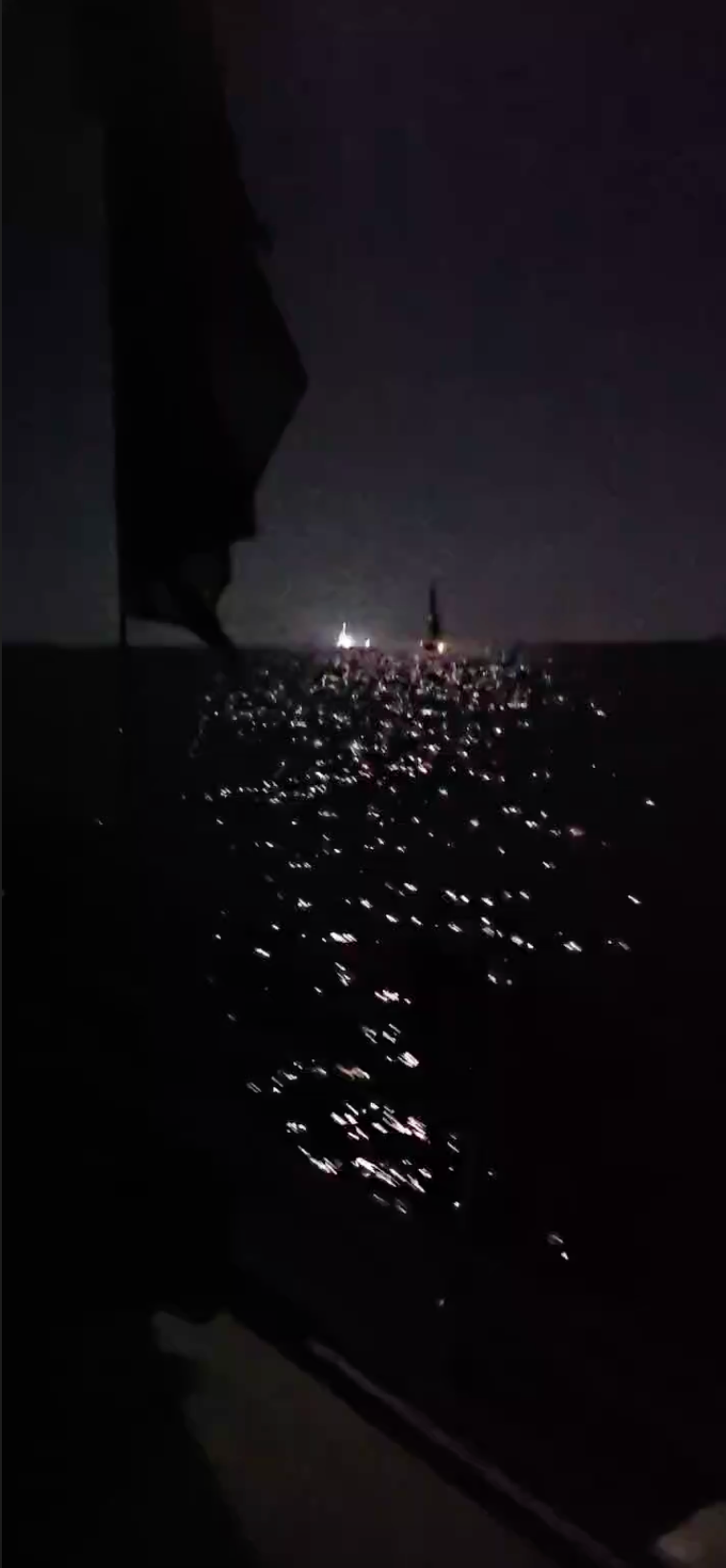
About an hour ago amidst heightened drone activity we saw a bright light up ahead and as we approached we could see a military rib boat violently ramming one of our sailboats. There were shouts in many languages and we could see red dots from rifle scopes swarming the boat and crew. Flares were set off and we stayed alongside to capture evidence for a few minutes then continued on our course.
April 29, 2026 22:58 BST
Latest news from our fleet command is that this is the IOF [Israel Occupation Force] performing illegal arrests in international waters. We’re motoring full steam ahead to try and get into Greek jurisdiction whilst they busy themselves with boats further back. Please forward to any channels available to you. Guessing the Israelis want to nip this in the bud before it starts garnering more media attention. This is kind of what this mission is about, to highlight the insanity of this regime and our government’s complicity. Thanks for all your support and kind words. All our love to you all!
More soon (hopefully)xxxx
PS, sorry mum, I know you hate it when I do crazy shit… 😅
Look at it from the bright side, there’s a full moon glinting off calm waters and all the stars are out, the crew and boat are in good spirits, Jamie is sitting on top of the mast looking over us, and…. they haven’t got us yet!✊❤️🌊
From Richard: April 30,2026 5:41 BST
Made it to Greek territorial waters. Regrouping and figuring next steps. About 20 boats confirmed intercepted so far. Seems we forced their hand by bringing more boats than they would be able to handle closer to Gaza, so they forced an early interception to cull our numbers before we get that close. Will keep you all updated. Xx
From Richard: April 30,2026 21:56 BST
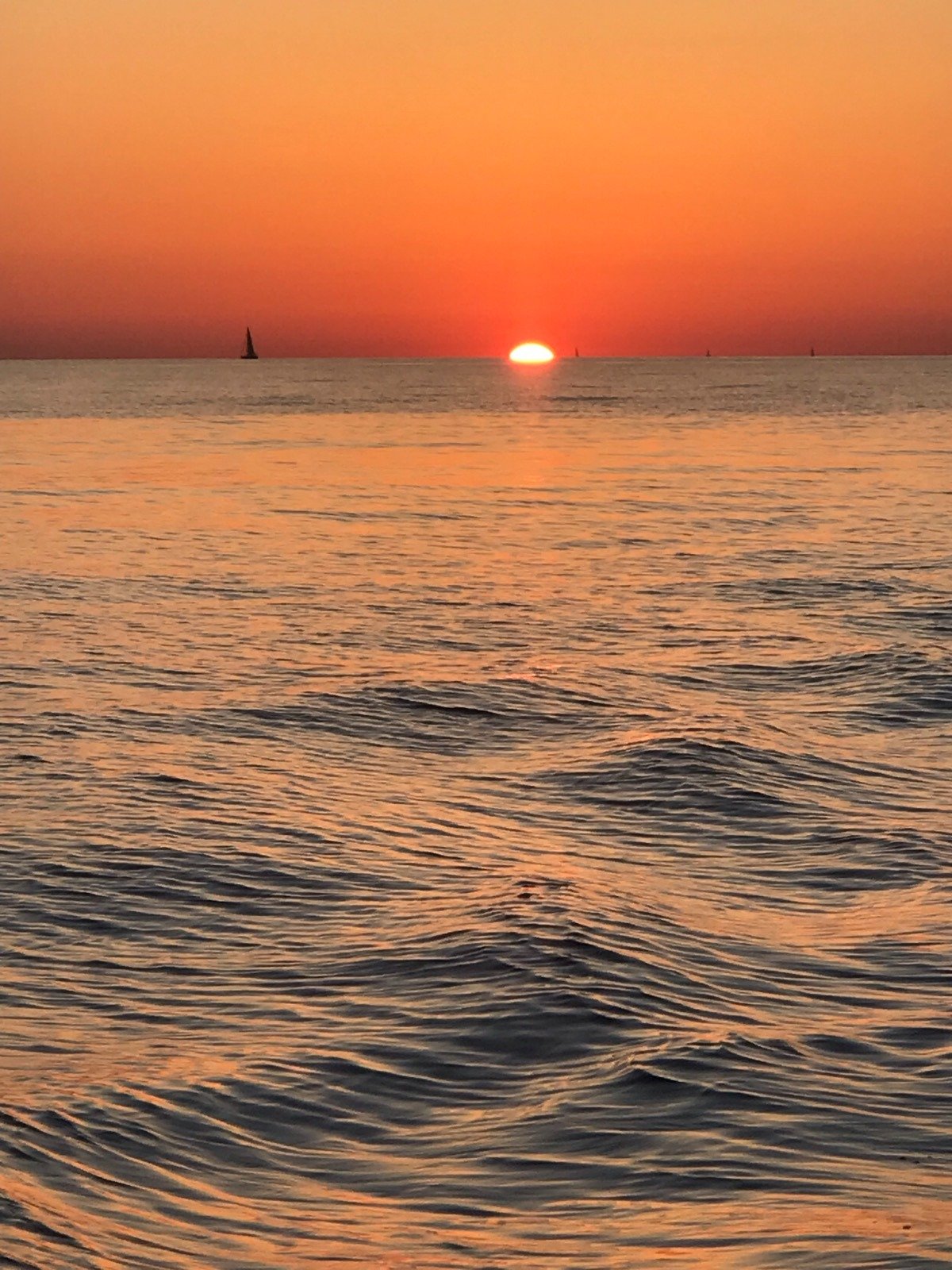
The remaining 32 boats of the flotilla are back together and sailing as a pack along the southern coast of Crete, huddled around the reassuringly large Greenpeace ship, Arctic Sunrise.
22 boats were intercepted last night and 175 activists kidnapped at gunpoint and currently held on a freighter somewhere in the Mediterranean. We think they might do the same again tonight to us, even within Greek territorial waters.
The Israelis left most of the boats afloat in the middle of the ocean after incapacitating them, some with the crew left onboard. Parts of our fleet have been busy rescuing crews and boats whilst the rest of us regrouped.
It’s been a welcome calm day after a pretty nuts night. It’s deeply heartening to feel everyone’s support, and to hear about the mobilisations happening in various countries to build on the momentum of this. The Turkish contingent of the flotilla are getting ready to join us, adding even more boats to our fleet.
The fact that Israel can violently intercept and kidnap peaceful activists in a humanitarian aid convoy 600 nautical miles from their ‘own’ shores with complete impunity is just another example of how complicit our governments are in the Zionist colonial genocidal project.
Another sobering thought is an old news report I saw when researching our next anchorage. In December last year, 17 migrants were found lifeless in a partly deflated boat off the coast of Crete, near the very same bay we’re anchoring in tomorrow. It says something about the relative safety we still enjoy, that because of our ‘whiteness’, our western passports, we are highly unlikely to get seriously harmed or killed. The same goes for time spent in Israeli prisons. For us it may be uncomfortable and humiliating for a few days, but compare that to the experience of Palestinians spending years in torturous conditions.
It always reminds me of the poem ‘First they came’. If we don’t speak for Palestinians today, who will speak for us tomorrow? And why is it so hard to speak for them? My tuppence is that it’s our complicity that makes us silent. Our material wealth in Fortress Europe is too sweet, we don’t want to share, beyond some meagre indulgences called aid, so we build walls and shut our ears.
To meaningfully share the resources of this planet, our living standards have to drop significantly. And nobody wants to accept that. Unless you offer them a meaningful alternative. But that might be a generational shift, rather than a revolutionary one.
I believe the only way we will shift our addiction to wealth and unnecessary luxury is by finding in ourselves the very thing we are stealing from the Palestinians: connection to land and sea. A deep connection that makes you part of a continuum of ancestors and worms and deer and carrots and olives and chickpeas and things that swim and things that fly. Nothing short of a major spiritual paradigm shift will do. Simple, right?
Damn I wasn’t meant to get on another soap box, I meant to tell you about the cute little idiosyncrasies of our motley crew of peace activists on this odd little ship of ours. But I’m on night shift, the moon is blazing, I’m watching an unbroken line of red port lights stretch across the entire horizon and I’m dreaming big, because sometimes you have to, right?
And once the Israelis come on board to wave their oversized willy substitutes in our faces, my diary goes overboard along with this phone, so you get a bedtime rant and I get a night in jail. Done.
Keep up the pressure and momentum, write to your MP, post on Instagram, show them you care, every little helps!
More soon (hopefully)
Xxx
Greece: ‘from people on the ground, the solidarity is enormous and humbling’
From Richard: May 1, 2026 11:19
The night was calm and uneventful. We’re being closely monitored but no action taken against us at sea yet. Frustratingly the Greek government are in cahoots with the Israelis and we can’t go ashore or dock for fear of being arrested and our boats impounded. They have also agreed to do Israel’s dirty work by deporting the kidnapped activists from here.
On the positive side the Turkish government have now voiced their support for the Flotilla. It feels like an uneasy alliance with another oppressive regime but there’s at least a swell of support globally given the outrageous state piracy of the Israelis.
A bit of disturbing news has emerged though. I’m sick to my stomach to hear that two key comrades, Saif and Thiago, have been taken to Israel for questioning. Thiago is a Brazilian national so his government will kick up a shit storm. Saif is Palestinian though, and the thought of him in Israeli hands is sickening. He never planned to come all the way with the flotilla, the early interception caught everyone off guard.
The flotilla’s steering committee has shared with us that due to the swell of support garnered by Israeli piracy, our mission has a much increased chance of actually getting to Gaza. That possibility brings a lot of questions and exponentially increased risk. Information about planning around that eventuality is not shared widely, for obvious reasons. When I know more I’ll share it.
Thanks for all your messages of support, your letters to MPs and sharing the stories and getting behind this. Love to you all!
Xxx
Are you safe today?
From Richard: May 3, 2026 9:10 BST
Yes we are safe, getting a bit delirious with cabin fever, probs still here for a few more days and scant outlook for shore-leave. Being on a boat full of impassioned Irish activists keeps the craic high, though my poor autistic brain sometimes requires me to wear my ear defenders to get some me-time… 😂
But we’re doing great regardless. We all wear our humanity on our sleeves and feel strongly united in our common cause.
Most of the niggles exist on an organisational level. A lot of people on the steering committee do not have the experience of managing this magnitude of operation and information flows can sometimes be stagnant and decisions sub-optimal. But everyone is learning. Learning by failing and accepting failure as part of the learning curve and moving on. Humanity is an imperfect project after all.
The niggles aren’t mutinous, but we are considering a wee naughty manoeuvre to boost morale. More about that later. I can’t remember who said “if I can’t dance it ain’t my revolution” but it feels deeply important. Joy has to be a core part of any revolutionary movement.
Just saw Catherine’s message about national news, that’s fantastic, it means the pressure is building.
We can leverage this!
More soon!
With love,
Xxx
From Richard May 7, 2026
Thanks for all your patience and support and letters and contributions and stories and amplifications. The lull in activity is for good reasons, though it feels frustrating! We waited out the storm at anchor, wrangling with Greek authorities to let us go ashore. Permission was finally granted by the local port authorities who simply ignored the government stance.
Our comrades who were kidnapped by Israel and held in the prison ship for 40 hours were unceremoniously dumped on a local beach in Crete. The complicit Greek government then tried to forcefully extradite them, but in the airport the entire cohort of activists simply refused to get on the plane, and proceeded to walk out of the airport with their arms linked, chanting “Free Free Palestine!” at the top of their lungs.
There’s a beautiful schism here in Greece between the official government stance of full complicity with Israel, and the reality on the ground where local port authorities, coast guard and airport staff amongst others refuse to toe the same line. From people on the ground the solidarity is enormous and humbling. The local anarchist squat put up many of our comrades who were severely beaten by the Israelis, ferrying them to and from doctor and hospital appointments.
Local people in the port routinely turn up with food and good wishes. Last night a group of musicians turned up and played traditional Greek songs for us. When their set ended it turned into a jam session and we all danced the traditional Cretan circle dances, followed by traditional Palestinian dabke dancing.
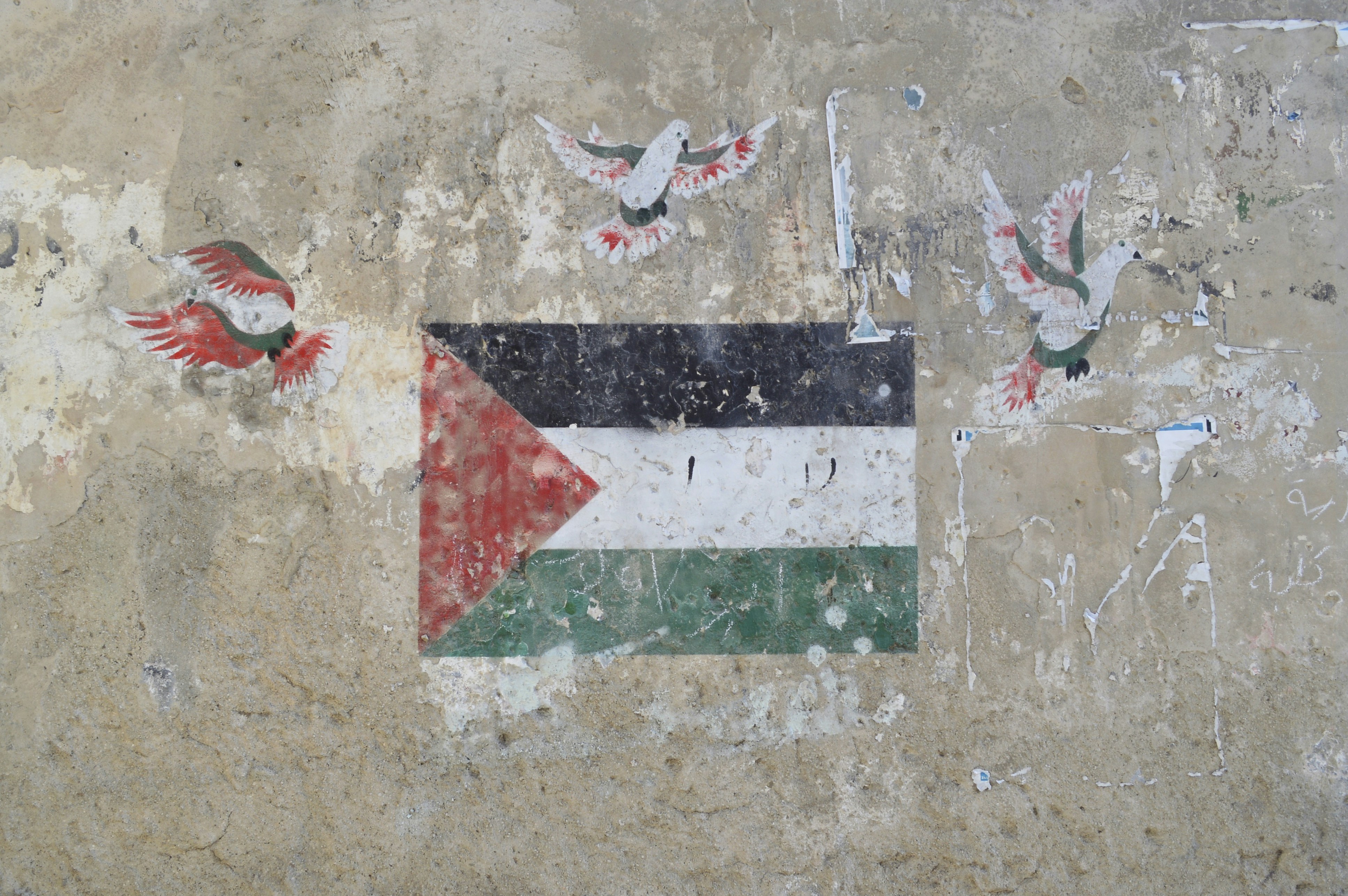
Spontaneous protests are happening across Crete and beyond, in classrooms and on road sides. Kids are running around with Palestinian flags and wearing t-shirts with the watermelon proudly emblazoned. The Flotilla carries a symbolic amount of aid, but is in large part a leverage point for mobilisations on land.
We will soon sail again. At some point Israel will stop us again.
We set sail for Turkey tomorrow morning. The Israeli frigate and prison ship sit just beyond the horizon. We’re sticking to Greek territorial waters and if the Israelis attack or intercept us there it will be a major escalation from their side and another media win for us. In Turkey we will be joined by another cohort of boats, and from there we sail on Gaza.
We will stick to our non-violent principles, it is the only protection we have. If the Zionists escalate they do so unilaterally and show themselves as the brutal bullies they are.
Please join us in raising your voices against injustice and complicity. Against colonialism and empire. We’ve set the ball rolling but we need your help to apply pressure where you can. Amplify the message, speak out for Palestine, write to your MP, shut down an arms factory, get your supermarket to stop selling Israeli goods. Fight the Zionist strategy to conflate anti-Zionism with anti-semitism. Vote Green. (Rødt in Norway!)
Free Palestine!
With love,
Us
Xxx
Richard and Alaa’s conversation: ‘you are not as far away as you think’
Alaa joined the group where Richard was sharing updates about the flotilla’s journey. He messaged Richard; Richard was moved by his message, and replied. The two men continued to exchange messages while Richard was at sea, building a relationship of reciprocal solidarity, bolstering each other’s commitment to their shared cause.’
Alaa has written this to introduce himself, before we get into the correspondence…
My name is Alaa. I was born in Gaza, specifically in Jabalia refugee camp, in 1994. Jabalia is the camp where our parents and grandparents sought refuge after they were forcibly displaced from the city of Jaffa during the Nakba in 1948.
I got married in 2015, and God blessed me with three beautiful children. Rahaf was born in 2016, Saloum in 2018, and Youssef in 2024. Born in the middle of war, destruction, fear, and displacement. Sometimes I look at him and wonder how a child can arrive into a world filled with so much pain, yet still carry so much light in his eyes.
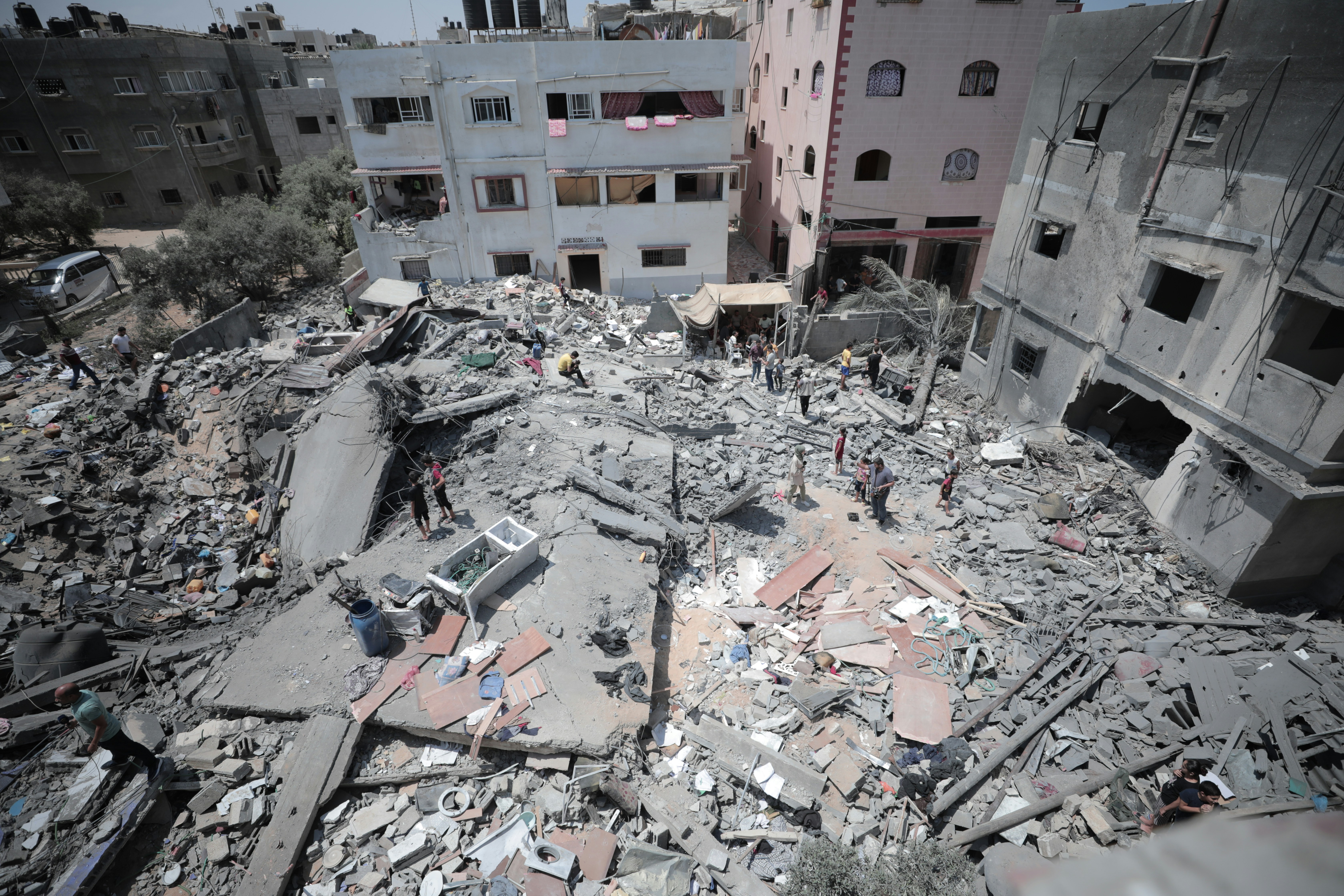
At the beginning of the war, our home was bombed and destroyed. I was injured, my mother was killed, and my older brother was also martyred. Since then, our family has lived through countless painful moments that are difficult to fully describe in words. Loss here is part of daily life. Yet we continue. We continue because we love our children, we still believe in life, because hope is sometimes the only thing left.
I do not want our story to be remembered only for death and suffering. I want people to know that we were ordinary people who loved life — we loved our home, morning coffee, family gatherings, children’s laughter, and dreams for the future. War does not erase our humanity.
From Alaa May 2, 2026 8:55
Dear friends,
My name is Alaa, writing to you from Gaza. I wish to share my deep appreciation for your موقف. Your words reached our hearts from the depth of the sea. What you are doing is not just solidarity, it is a moral and human stand in a time that tests conscience.
What you are doing, through attention, words, and موقف, is not small. These simple acts are what keep truth alive. History can be written by individuals who chose not to stay silent. We draw strength from your courage. We will unite our voices, we will keep repeating our message. Persisting is a statement in itself.
From Gaza, I tell you: you are not as far away as you think. Your impact reaches us, your presence reminds us we are not alone.
With all love and respect, stay safe
Your brother, Alaa
From Richard May 3, 2026 9:17
Dear Alaa
Thank you so much for your words, for joining us, for inviting us to believe that what we do matters. It is humbling and fortifying. It can sometimes feel so futile and small. To hear from someone on the ground in Gaza that our actions and words have a real impact is all the motivation we need to keep going. To keep trying.
We hold our comrades Saif and Thiago and all of Palestine and oppressed people everywhere in our hearts. We will not stand down, and if they must use brutal force to stop us, we might just wake more people up to that brutality.
The whole world came together to oust apartheid in South Africa and with political will it is possible to isolate Israel in the same way. The flotilla is opening a space to have those conversations more widely and more forcefully.
As we sail, anyone on land could make use of the opportunity this is creating to have those conversations in their respective countries. The Boycott/Divest/Sanction (BDS) movement is what Francesca Albanese wants us to focus on. Maybe the flotilla could be the thin end of the wedge to leverage those conversations on a national or EU level.
But regardless of all that, our brother, if the flotilla does nothing more than remind you that the beating heart of humanity is on your side, it is worth it. We will keep sailing and knock our heads and hearts and boats against that wall again and again and again.
With love and humble hearts.
Us
Xxx
From Alaa May 3, 2026 9:18
Richard and crew…
My heart is weighed down by pain yet overflowing with gratitude. My words shake before the magnitude of what you are doing. You are redefining what solidarity means.
We are here… in a land exhausted, living what words can barely carry. The knowledge of your presence is like a fragile light reminding us that the world has not entirely gone dark.
I wonder, how do your homes, your families, hold the weight of your absence while you stand in this exposed space of moral courage, far from comfort, close to truth?
We send you gratitude that cannot be measured, love that cannot be contained, and a sincere prayer that you are protected as you protect our shared humanity.
Stay safe… the world needs you.
With deepest love and gratitude
From Gaza 💔
From Richard May 4, 2026
Dear Alaa
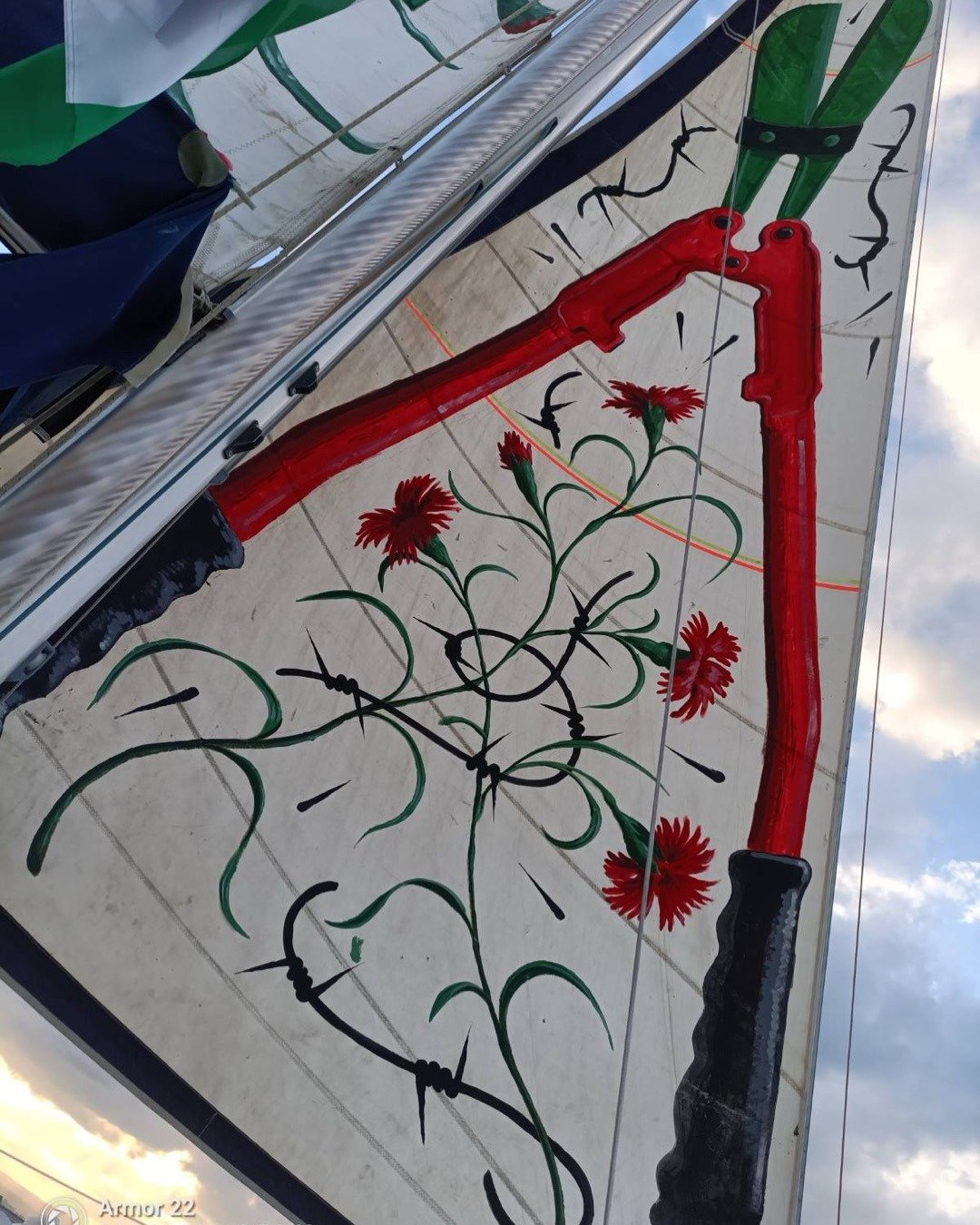
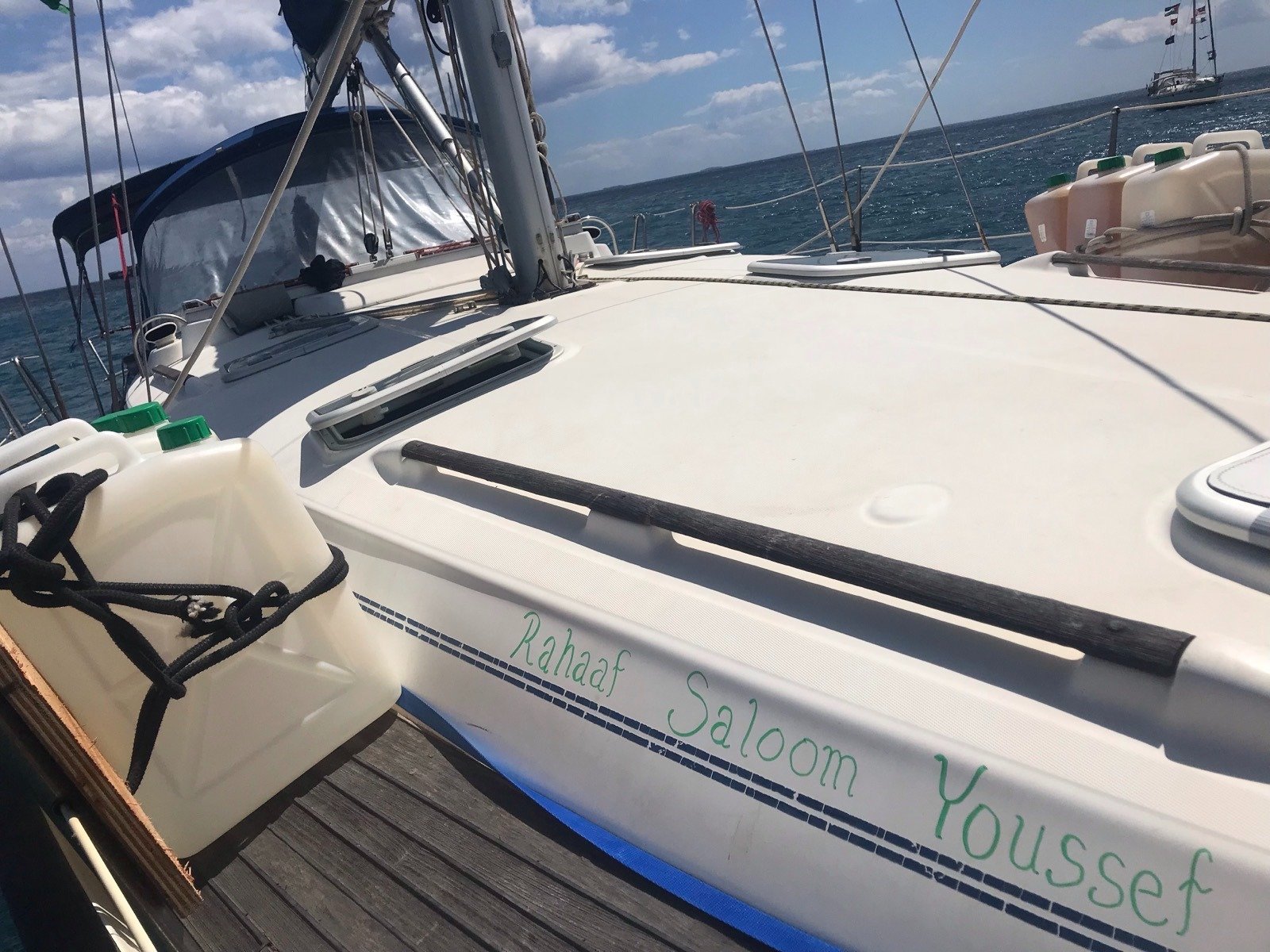
Your children’s names are written near the bow of our ship, to best feel the wind and the waves and the salt spray vicariously from your humble home that you have filled so tenaciously with love and hope despite everything. I cannot begin to tell you how humbled and honoured I feel to have you with us. Your frank and eloquent sharing of pain and hope both breaks my heart as well as bestowing courage to do everything I can to sail towards Gaza despite anything the Zionist rogue state pirates can throw at us.
I will share more another time. I’d like to introduce everyone here to our motley crew of peace activists and give you all a little glimpse of life on board our proud ship Ajjur.
All our love!
Xxx
From Alaa May 4, 2026
In Gaza, childhood no longer looks like childhood. My children have never woken up to the sound of birds, but instead to explosions, and rats moving through the rubble. They spend their days running with me searching for food, firewood, or a drink of clean water. It is a painful daily struggle. My children have endured what even armies could not bear. Their laughter is quieter now. My children have suffered an injustice that the history of humanity should never forget.
The sea of Gaza, which once healed our hearts, has become a distant dream to swim in again.Its air is polluted, its streets destroyed, and our memories torn from their roots. Every corner here once carried warmth and life, and now we are simply trying to survive.
Please share our story.
Tell the world that families here are still fighting to survive, and that children here deserve life, warmth, safety, and the chance to have their stolen childhood returned to them.
From Richard May 11, 2026
“Those who build walls are their own prisoners. I’m going to fulfill my proper function in the social organism. I’m going to unbuild walls.” Shevek
Jamie wrote once that Shevek’s example was a tough one to live up to. I have to say, Jamie, so is yours, but your inspiration keeps me going. How do you unbuild walls when you see them everywhere? Not just in Gaza and the West Bank but all around us here in Fortress Europe, like onion layers encasing us, where the inner layers are so thin they’re invisible.
We’ve dropped anchor in Marmaris, Türkiye, a huge natural harbour surrounded by a doughnut of mountains and forested hillsides. Cluster pine, oak and plane jostle for space with wild olive, rosemary, sumac and bay. A yellow gorse-like bush I’ve not identified yet coats the hillsides in an impenetrable thicket. The national park here boasts bear and lynx and wild goats and a rich variety of bird life. The enclosed seascape reminds me of a Norwegian fjord or Scottish loch.
We arrived late Friday night, 60 boats in single file through a narrow sound, and lit flares as we entered the bay, greeting our comrades in the Turkish flotilla, who are preparing to join us on the next leg. I have to say that pyro-technics and night vision don’t mix particularly well, but we survived the gesture without incident.
Leaving Lerapetra in Crete was emotional. After so much beautiful solidarity from our Greek comrades ashore, the whole fleet rallied around the Greenpeace ship Arctic Sunrise who have escorted and supported us so far. Fog horns ablaze we wished each other fair winds as we parted company.
The Turkish government has been very supportive of the flotilla and we encountered nothing but friendliness and goodwill from government officials. But it’s a two faced friendliness from higher up in the system. The government here have their own agenda and it’s hard not to feel like just another pawn in their geopolitical gaming.
Türkiye is a colonial power, like England and the US. They’ve ravaged the Kurdish minority for decades and have an abysmal human rights record. The insane wealth amassed from colonial exploits is expressed very clearly here in port, where super yachts and galleon replicas jostle for space with ostentatious hotels and shiny casino bars. It is making me a little bit sick to be honest.
Alaa, my brother, I feel embarrassed about this. Because even if I can distance myself from its most vile expression, I am still part of it. I still have the privilege of choice.
The Flotilla as a civil disobedience movement is somewhere in its adolescence. It has set some incredibly impressive things in motion. It has learned valuable lessons from previous missions and is building on those. But I’m also looking forward to conversations around how we grow as a movement. We need those conversations to try and avoid the risk of replicating the very systems we profess to work against. It’s hard and clunky work sometimes.
I take refuge in music and song, as always. One of the boats with us, the Shireen, was named after the brave Palestinian journalist who, like so many of her profession, was targeted and murdered by the IOF. On the Shireen we have a nightly live pirate radio show, WaveZero, run by a French anarchist squat based in Lyon. Songs of hope and longing and resistance fills the air, and our hearts and our souls. Hope can be a fragile thing, but music sustains it. The next show is tonight, 2130 Istanbul / Gaza, 2030 Oslo, 1930 London. Join us!
Alaa, let me know if you have the bandwidth but lack the data, I’ll see about sorting out an e-SIM if that works on your phone. DM me, would love to dedicate a song to you!
Where and how we go from here is currently being discussed by the fleet coordination committee, and will be opened up to a wider debate in the General Assembly tomorrow. The assumption is that we’ll carry on towards Gaza, in an attempt to somehow get past the Israeli navy with their drones, ribs and stealth warships. It feels like we have to try, that there is a moral duty for at least some of us to do this, whilst others mobilise on land in so many other ways. The ripples of solidarity feel very real.
I wish I could tell you that I’ll see you in a week, Alaa, but it’s more likely that I’ll be staring into the grotesque face of the same industrialised war machine that has turned your home to rubble. If this dragon won’t be slain or reasoned with, what is left? To witness it, perhaps. To sit with the uncomfortable truth of our shared ancestry. To recognise that as much as I am proud to call you my brother, Alaa, I am also related to the dragon.
Can we unbuild enough walls around ourselves and each other to undo the spell that holds the dragon captive to its voracious and destructive appetite?
With hope in our hearts, and solidarity in our songs!
Xxx
From Alaa May 7, 2026
Rich, my brother…
Your messages are waves striking the walls around the human heart, trying gently and stubbornly to break them open. Your words are those of a man fighting governments and warships, and also fighting himself, his own comfort, his own privilege, his own invisible walls. These can be the hardest battles of all.
You spoke movingly about music on the Shireen. In Gaza, we know that songs are shelter. Sometimes a melody can hold a broken soul together. The songs played from your pirate radio crossing the sea at night, carrying songs of resistance and longing, reach farther than borders and navies.
You asked how we unbuild walls. Maybe we start exactly like this. One human soul speaking honestly to another across oceans, wars, languages, and histories. Maybe every sincere word is a small crack in the prison surrounding this world.
I do not know what waits for you at sea. I do not know what waits for us tomorrow in Gaza. But I know this: some people pass through history quietly, and some leave footprints that remain in the conscience of humanity. You and your comrades are marking history.
If the sea blocks you, if warships surround you, if the dragon roars in your face as you said… then let history witness that there were still human beings who sailed toward suffering instead of away from it. You said you are related to the dragon. But the fact that you are horrified by it means your soul still belongs to humanity.
My brother, I hope one day we truly meet. Not through screens, not through war updates, not through grief and ashes. I want to meet you in a free Palestine. I want my children to hear your songs under olive trees beside the sea. I want you to see Gaza when it laughs again.
Until then, keep your music loud enough to challenge the sound of war. Know that somewhere in the darkness of Gaza tonight, your songs are being felt.
With love, pride, and solidarity always,
Your brother, Alaa
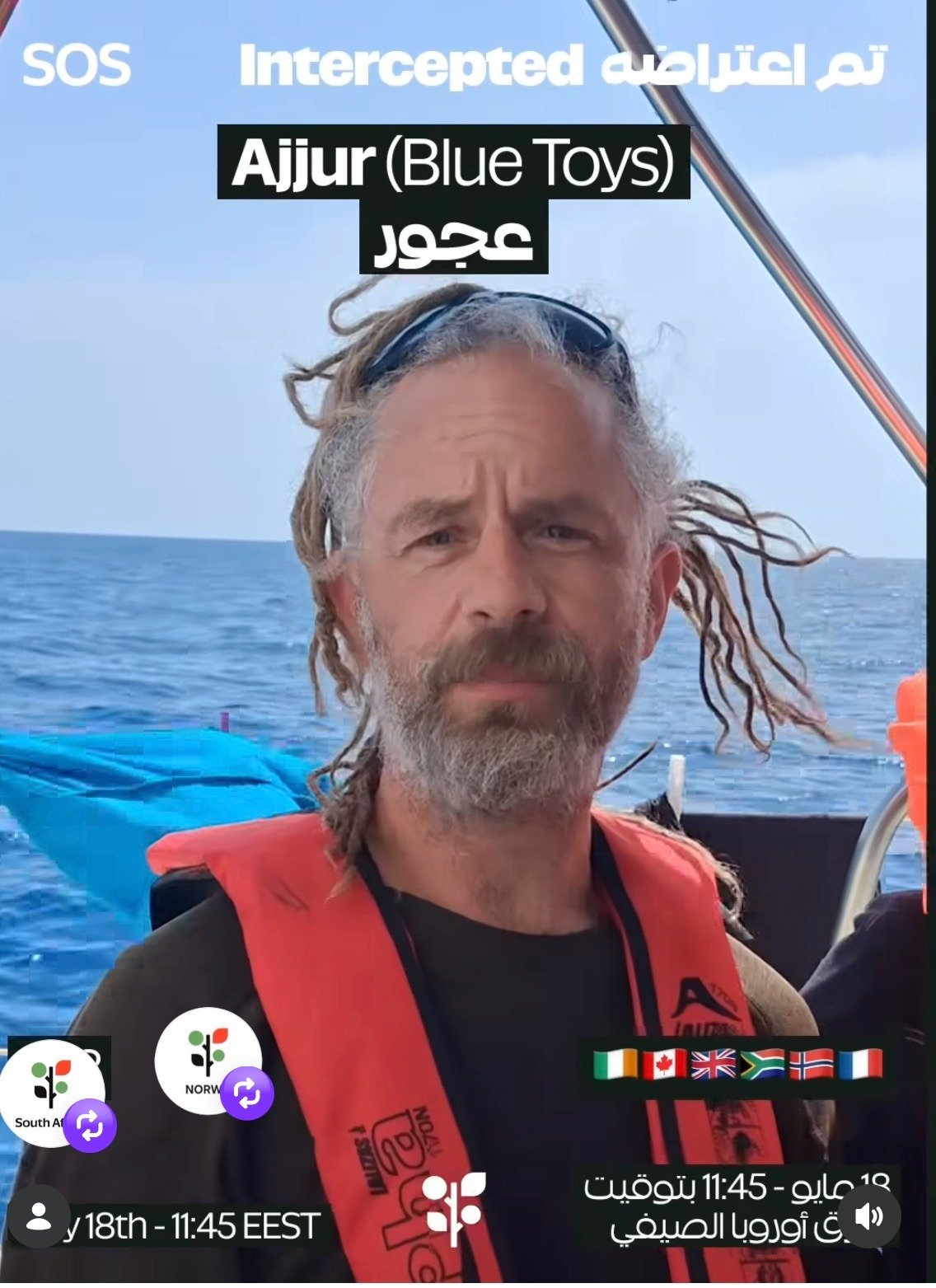
Interception, capture, and torture
‘On the night of 18 May, the Ajuur and all of the boats of the flotilla were again intercepted by the Israeli navy. Richard and 438 of his comrades were captured.
After he returned, Richard wrote this description of Ajjur’s interception, and his kidnapping and suffering at the hands of the Israeli military. This is tough reading, including descriptions of torture.
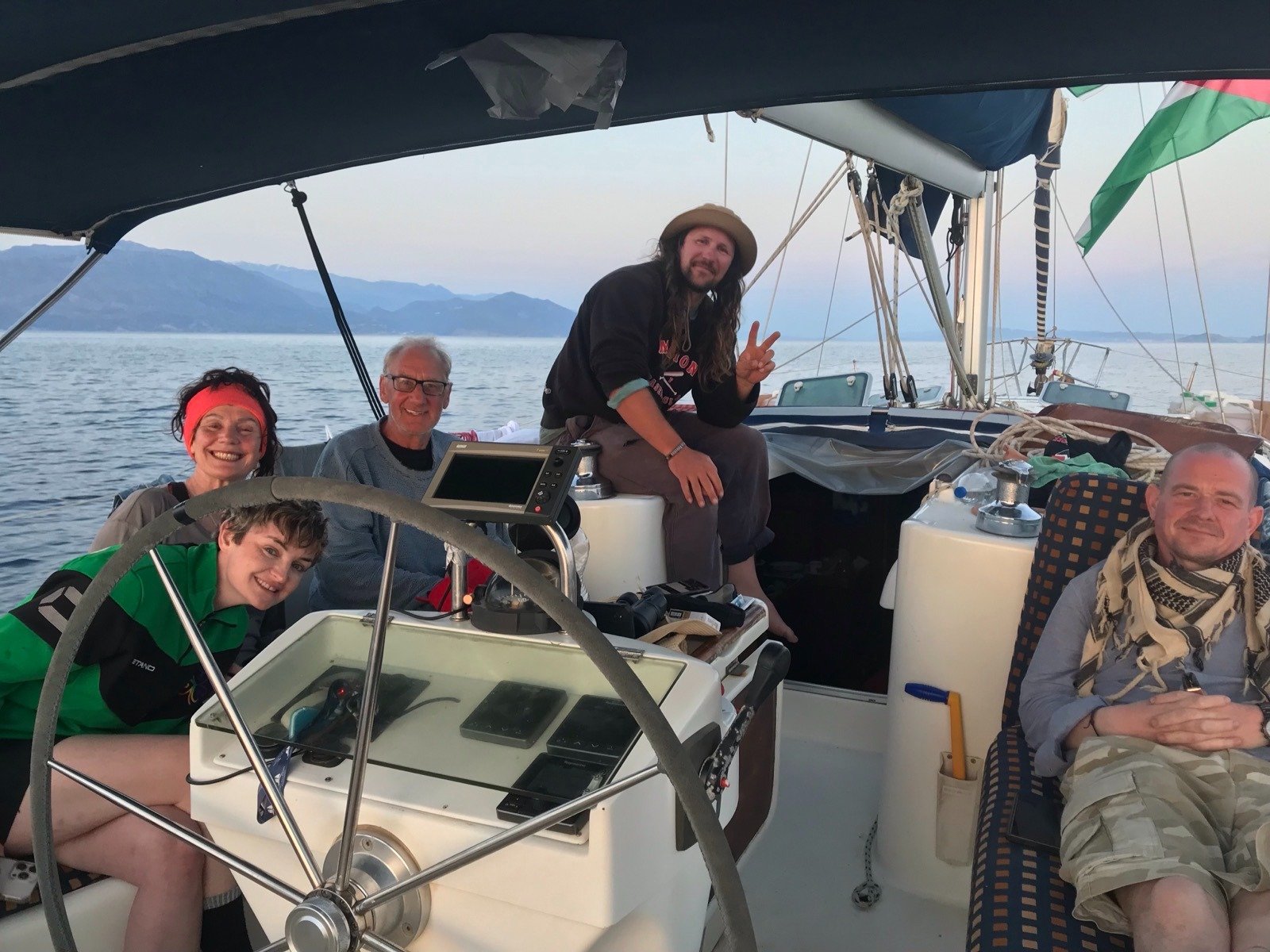
We were intercepted by an Israeli military rib, with about a dozen masked and armed soldiers who shot at us before boarding. We were taken on board one of the two purpose-built prison ships that they employed to kidnap us. From the moment we entered the ship we experienced a darkly dystopic, carefully designed and engineered architecture of abuse, humiliation and degradation. Every soldier was masked, their eyes shone with either hatred or indifference. But we rarely saw their eyes, as we were either forced to kneel in stress positions with our hands zip-tied behind our backs, heads on the floor, or moved from station to station with backs bent, head down, arms forced up close to breaking point. We were stripped and beaten. Names and passports taken. One comrade was concussed when her head was slammed into the deck with brutal force. Another 70-year-old comrade was kicked so hard in the ribs whilst kneeling he could hardly stand up for the next two days.
We were made to kneel in front of a panel who asked our name, passport and which boat we were on. I remember the nail varnish on the person questioning me. She averted her eyes when I looked straight at her and the guard behind me beat my head down.
From being recorded, wrist banded and dismissed we were violently bundled one by one into a large, dark shipping container. The first thing that met me was a fist to the head, followed by kicks, and more punches. I could just about make out three masked Israeli soldiers when my eyes adjusted to the dark. I was violently slammed against the wall, and one of the soldiers asked where I was from. When I said Norway he said ‘Valhalla, see you there’ and kicked me out through the side door of the shipping container, into the open-air compound in the middle of the ship, where me and my comrades would spend the next two days and nights.
I got away incredibly lightly. It felt random, who they targeted and the treatment each got. Skin colour was not a defining factor. But anyone wearing Palestine solidarity t-shirts, jewelry or tattoos got it really bad. If you looked big and tough they had it in for you.
We were kept in a holding pen made up of four large shipping containers in the middle of the boat, open to the sky, hemmed in by barbed wire. Three of the containers were for sleeping, the fourth was our torture chamber. It was designed so that we would be forced to listen to each and every comrade as their bodies slammed against the wall of the container. A fresh batch of comrades would come tumbling through the door after each boat’s interception. We learned to differentiate between people screaming out in pain, and the anguished cries of terror when the soldiers would get more creative in their approach. Over a dozen counts of sexualised violence were recorded by our medically trained comrades. More than 30 broken bones were counted, mostly ribs, but also a broken wrist and a broken foot from a rubber bullet. One comrade had his back full of bloodied welts from being repeatedly tasered. One had taser wounds in his face. Four had severe head wounds and two had concussions. Every comrade who came tumbling out of the shipping container had a look of ashen terror on their faces, as we took them into our arms. Some cried. Some smiled through gritted, bloodied teeth. Muslim women would have their hijabs removed and desperately cover their hair until we could muster scraps of t-shirts and other bits of cloth for them to cover with. One comrade was pushed out the door backwards and his head landed on the steel deck with a loud crack. Some comrades were so traumatised their hands were still locked behind their backs even when the zip ties had been removed.
By the second night we were 180 comrades on the ship. 60 people per container, less space than a cattle cart. Stripped of most of our clothes we huddled together for warmth. Some standing. Few slept. It felt reminiscent of train carts on their way to concentration camps. Guards standing on the walkways above us would shine their torches and flood lights at us through the night, moving their laser sights across our bodies in a banal dance of domination. Occasionally they would flood the compound with sea water in the middle of the day, making everyone scramble inside the containers. We entered with nothing and had to make loud pleas for water, scraps of bread, toilet paper and sanitary pads. As we stood shouting at the officers on the bridge for sanitary pads, a female comrade beckoned me inside one of the containers to give me a scrap of cardboard she wanted me to hold up to the guards. On it, it simply said “PADS” in large red letters. She had written it in her own blood.
Our reality turned into a monotonous routine of deprivation and humiliation. When they brought us water or bread they would do so by throwing stun grenades into the compound, making us all scramble to the back. Armed soldiers with shields and full riot gear would step out in front of us, guns pointing at our heads, while one soldier dropped a crate of water behind them. Then they all filed out. This juvenile display of power repeated itself several times in the three days we were there. It was a strange mix of unnecessary theatricality, bullying and calculated scare tactics.
Days were long and hot, nights uncomfortable and cold. But strong bonds were forged in the shared brutality of it all. We tried to guess where we were going by looking at the sun and the speed of the water passing the ship that we could just see through a gap under the shipping containers. When they caught on to this they shot us with rubber bullets to make us stop looking. More boatloads of intercepted comrades would be put through the ringer, day and night, and we stood to welcome them.
—
On day three they took us to Ashdod port, another conveyor belt of beatings, humiliation and torture. A now familiar sequence of riot squad, zip ties, stress positions. We spent a couple of hours like that in the blazing hot sun, whilst they played the Israeli national anthem at full blast through the ship’s tannoy. An American-accented voice shouted at us, calling us ‘fucking terrorists’ and promising to shoot anyone that moved. My feet felt like they would fall off. At one point I heard two jets fly overhead in the direction of Gaza, and my heart shrank.
Then, one by one they threw us into a four by four metre gazebo to be met by fists and kicks. Next tent, back in the stress position, another hour or two like that with the national anthem playing again, this time accompanied by the screams of tortured comrades as they picked us up one by one for the next ‘treatment’. One person had his jaws forced open with pliers whilst being beaten senseless. Gun barrels and batons were forced where they shouldn’t be. The next few stations were in the terminal hall of Ashdod port. We were manhandled and pushed around to sign papers, which we all refused. Those of us with shoes still on were told to remove them. They finger printed us and now I grieve the thought I may never be able to see Palestine with my own eyes. At one point they even let us speak with our lawyers from the Palestinian legal centre Adalah, but the whole process was a sham.
At the end of the line in port our zip ties were replaced by handcuffs and we were passed into the custody of prison guards. Different uniforms, same story. In one holding cell we were 27 men in a 2.5×2.5m space with almost no ventilation and we took turns kneeling to the floor to breathe fresher air from under the door. Several hours in a cramped metal box with the air conditioning on full blast wearing handcuffs that restricted blood flow to our hands. If we complained about our cuffs they’d tighten them. One comrade had his hands cuffed behind his back despite having a dislocated shoulder, and his pain was so unbearable he came in and out of consciousness. The prison guards ignored our shouts for medical treatment.
The final stop before they gave us a thin mattress and four hours to sleep was watching a graphic video of footage from the 7th October attacks. I got the sense that this wasn’t only forced on us, but that the entire Israeli population was being retraumatised on an ongoing basis to mould people’s minds and facilitate the dehumanisation of Palestinians that allow these soldiers to see them as rats and cockroaches and worse. Something disgusting to be stepped on and blotted out from memory.
—
The next afternoon, after several hours in another small metal box, we were sitting on a Turkish Airline plane with hosts serving cups of tea and handing out warm towels. A Turkish delight was the first solid to pass my lips in four days. The experience of sitting on that plane and eating my fried salmon airplane meal is by far the biggest cognitive dissonance I’ve ever experienced. I was in a dystopic Israeli prison hell-hole that morning. And here I was, the strength of my passport giving me free passage out and away and home again, to friends and hugs. My relative privilege has never tasted as bittersweet. And I have an open wound of survivor’s guilt for my Palestinian comrades still stuck under the rubble and inside the extremist Zionist prison system.
—
So where do we go from here? I like to see this point in time as a beginning, not an end. I would like to carry on generating meaning from this, to build on both the solidarity and the resistance we’ve set in motion. I’ve befriended a beautiful soul in Gaza as a direct result of my involvement with the flotilla. It feels so important to keep this connection alive.
I would like you all to feel inspired to take action. Do what feels possible within your circumstances. That’s what I did. But meaningful action always comes with sacrifice. You don’t get to a fairer and more just world without giving up on privileges, because the resources simply aren’t there for the whole world to live the way we do in the affluent global north. Get in touch with your local Palestine Solidarity network. Join a protest. Support the Boycott, Divestment, Sanctions movement. I want you to be a little bit scared that if we let Gaza happen we’ll be next. But have the grace to let yourself off the hook from time to time as well. Doing something small every now and then is still better than doing nothing at all. If you want to get in at the deep end, visit Global Sumud Flotilla online and sign up for the next mission.
And here’s one: radicalise your parents. Let them see the white European bodies being battered by Israel, because the sad truth is, for middling classes, that is often what it takes for people to speak up. I thoroughly radicalised my parents during this mission. My dad has written no fewer than three letters to the prime minister of Norway in the past couple of weeks, calling him a coward and asking him to call out Israel. Can you imagine if we all got our retired parents to do the same? There’s potentially a whole pensioner army with itchy fingers ready to write angry letters to their MPs. If you give them something to say they have plenty of time to say it. We need to reach middle England, and middle Wales for that matter, to get outside our echo chambers. I’m considering a speaking tour of the Women’s Institute next, or something of that nature. I don’t want to preach to the converted. I want to have conversations with people who don’t have access to the information I bring them. It’s a long game, but we have to try.
—
I want to end with a message from Alaa, my dear brother in Gaza who watched his mother and brother blown up by Israeli rocket fire. Whose neighbourhood was bombed on the day before I returned to my home in Wales. The friend who has made this personal for me.
From Alaa May 3, 2026
To Richard and crew;
Reading your message makes the distance between Gaza and your boats disappear, as if we are standing on the same side of a shared human frontline, part of a long line of people who refuse to accept injustice as ‘normal’. From Gandhi, who broke empires without weapons, to Nelson Mandela, who turned prison into the beginning of freedoms. Throughout history, during the Ottoman era and other empires, the seas were always a space of struggle between power and humanity – between those who tried to turn the sea into borders of control, and those who made it a path for life and people. The flotilla continues this tradition. Racism in all its forms has always tried to convince the world that some lives matter less than others. But history always has, and always will, rise again to say the truth: humanity is one, and dignity belongs to all of us. In the words of Martin Luther King Jr; The arc of the moral universe is long, but it bends towards justice.
With deepest love and gratitude.
From Gaza.
Alaa’s family needs regular donations to survive. Please consider setting up a regular donation to his crowdfunder
Richard is home safely now, but Alaa, his wife and his children remain in Gaza. Alaa has 3 children and his wife is currently expecting a fourth child.
Across Gaza there are still persistent food shortages and the humanitarian aid that enters through legitimate aid agencies is very limited. They live in tents with access to only small patches of land where they grow basil and greens.
Unfortunately this means that families there are dependent on the black market for goods brought into Gaza and sold at inflated prices for their basic survival. Alaa’s family needs $1,000 a month minimum to buy the most basic food, clothing and the occasional toy. Alaa is locked into having to raise the funds for their necessities through crowdfunders. The money is transferred regularly to them through a cryptocurrency wallet by activists supporting them in solidarity. Alaa has to exchange the cryptocurrency for shekels at really high exchange rates, which have at times risen to 40% but are currently at around 10%. Unfortunately, many greedy people profit from their scarcity and hunger.
It is a horrible situation, but until Israel is forced to open humanitarian aid corridors and free transit of goods, and allow Gazans to rebuild their lives, they are completely trapped in this extortion and we can help by setting up a regular donation.
We are hoping that a group of supporters will donate regularly with a solidarity collective economy ethos.
If 50 people donated $20 per month we could cover basic costs for Alaa raising his family in the rubble of Gaza.