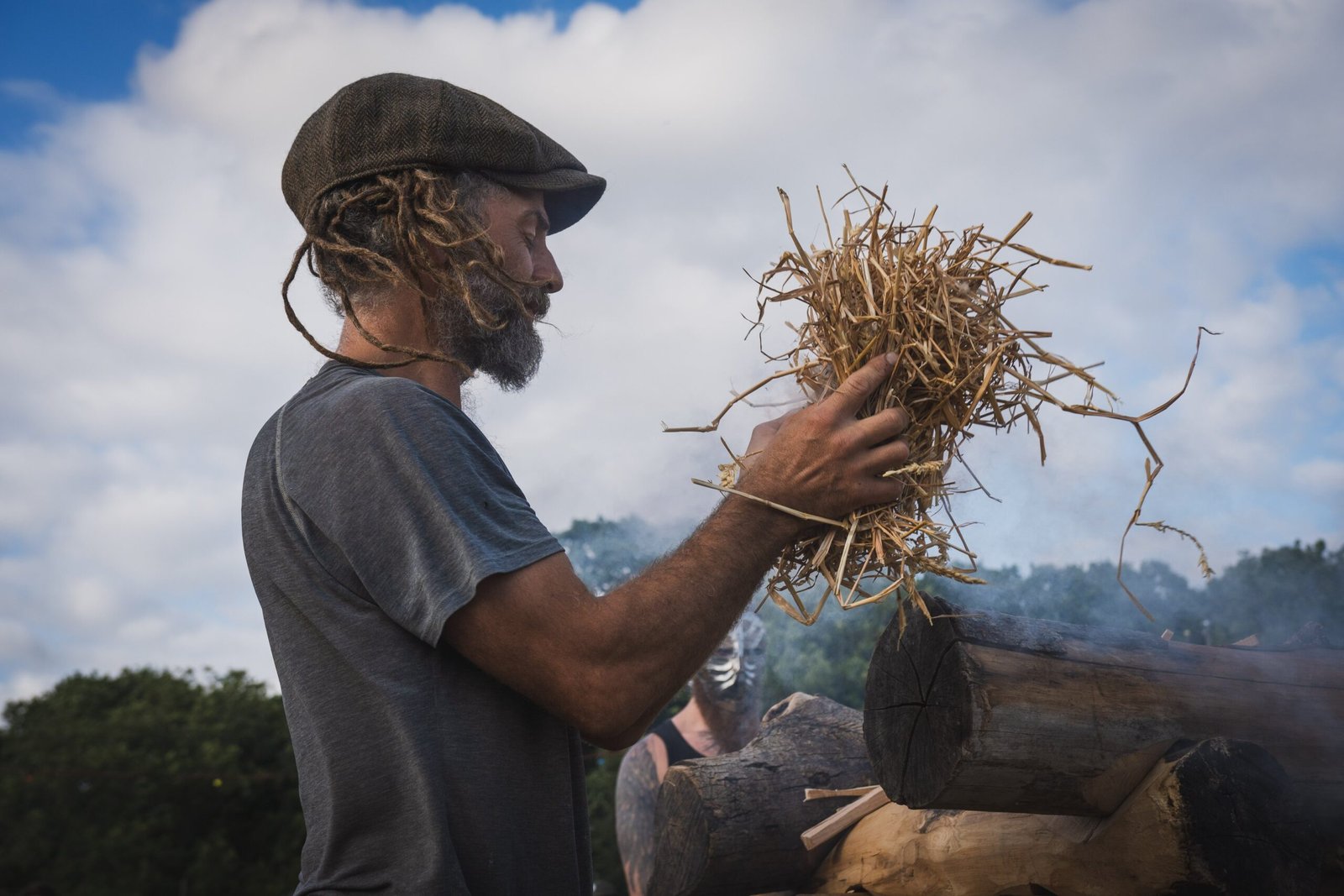
From April to May we had 3 separate week-long courses in roundwood timber framing for the Norwegian ‘grindbygg’ system. Richard Andersen led the build, combining modern roundwood timber framing methods with this ancient system developed by and for farmers to create fast, strong and durable structures.
Author: fivepennyfarm
-
Solstice Celebration ✨
Join us for our annual potluck feast and solstice celebration — singing, ceremony, and dancing to the amazing Skalatans band to celebrate the coming of the light.
-
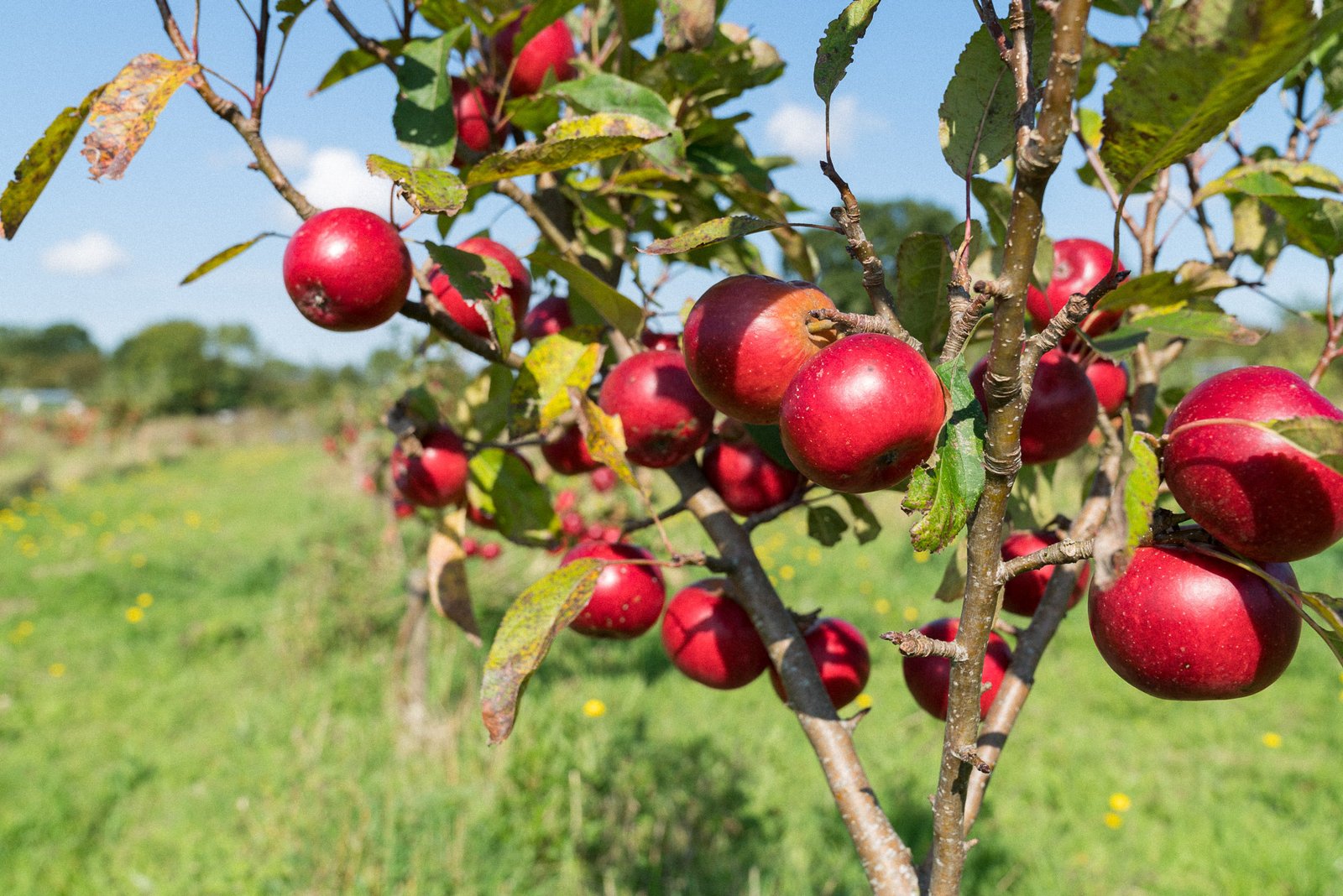
Apples, Art, and Anarchy
Fivepenny’s Land Skills Hub steering group meeting and apple pressing session — a mix of learning and chaos!
-
Plums, Ponds and Politics
A week of plotting politics, picking plums, building ponds and playing! Plus the Plums, Ponds and Politics PARTY! Featuring KMT Freedom Teacher & Soul Sanctuary, growing, workshops, farm tour, forestry, natural building, crafts & more.
-
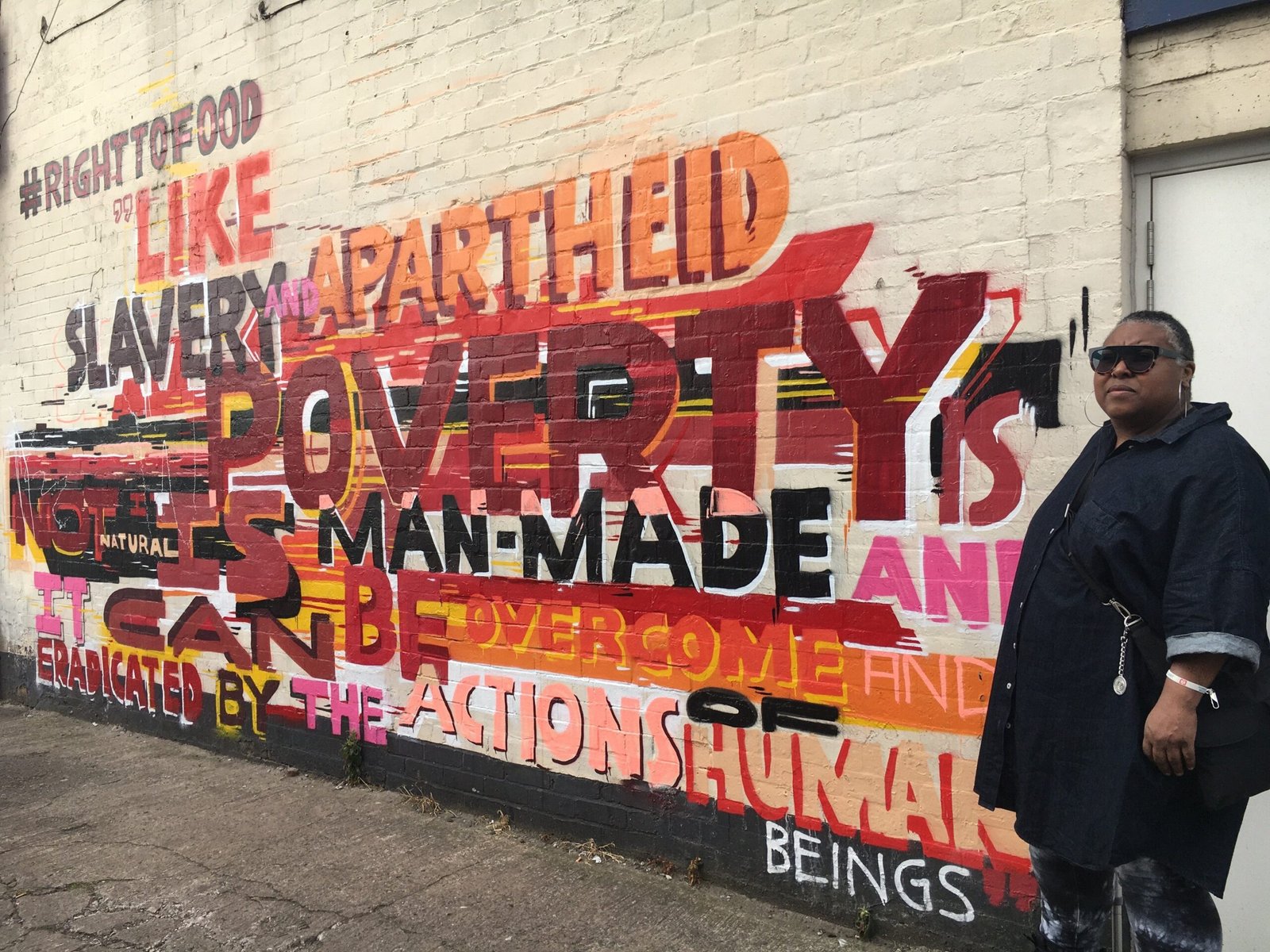
Dee Woods on racial food justice – interview by Jozina Calliste
JC: Thanks for agreeing to have this chat today, Dee. Could you tell me a bit about yourself and your journey into food justice?
DW: I’m a London girl, born in Ladbroke Grove. I’ve always been surrounded by food. That influenced a lot of what I do. I moved to the Caribbean when I was young and was immersed in this really diverse food culture. Celebration and connection and community comes with food. Whether we’re grieving someone, celebrating their lives, or celebrating someone going on a journey, coming back from a journey… Food is central to everything. So what I do right now, I teach people to cook, in a way that sparks joy and that curiosity to experience flavour and texture and smell and taste.
Alongside Leslie Barson, I run the Granville Community Kitchen. We co-founded this in 2014 because we could see increasing food inequalities through our own charity work. In our experiences of youth and community work, health promotion, from working really closely with people.
Granville Community Kitchen was born through drawing on my experience as a food grower from a farming background and aspiring to be back on the farm (laughs), coming from a strong community. I’d experienced food insecurity because of disability benefit decisions and literally not having any money. Having to decide What do I do? Do I pay bills? Do I eat? Do I feed my children? And seeing that happen with other people, I thought there must be a better way to do this.
JC: It’s great you brought up the celebratory nature of food in the Caribbean, alongside the harsh realities of austerity and disability benefit decisions and what it’s done to people’s lives, and the need for food justice in inner-city areas. What does a feminist food struggle look like to you?
In the 80s, I worked to create spaces for women of colour using womanist, black feminist perspectives. We created spaces where people could heal and get mental health support from other women of colour.
For me, it’s important to have that lens – feminism needs to be intersectional in food justice. One that focuses on our intersectionality of race, gender.
And how food is used as a weapon. So when we talk about food apartheid, it is a militaristic strategy to deny people food. So that you weaken them. When the most affected people are women – especially women of colour. Which is how it fits into a wider white-dominant system.
A feminist food struggle would have to be one that is queer/gender diverse, centres women, disabled people and people of colour at the centre of organising and co-creating the alternatives.
JC: Whose voices are missing in discussions around the right to food?
We’re missing the voices of the people most impacted by food insecurity – disabled, elderly and working-class people, women, people of colour, children. Also, people from the north who are greatly impacted by food inequalities, rural voices, including farmers and food producers.
JC: Who are the women in your communities who inspire you in fighting an unjust food system?
The elder women inspire me. Because they’ve made it to their 80s/90s and they come with dignity and so much joy. Even if they might be suffering due to inequality.Firstly the late Beryl Gilroy, writer and teacher,(Paul Gilroy’s mother) who was one of the founders of Camden Black Sisters which I was part of from the mid-80s to early 90s. In Trinidad, the late Mrs Nesta Patrick nurtured and guided my feminism as a young woman, giving me my foundation in understanding activism, patriarchy and women’s rights
Two ancestors – my paternal grandmother Elsie Woods nurtured my fascination with food and plants. For a child coming from Ladbroke Grove, she was this wondrous Iyami Aje [1]. My lasting memory of her is walking everywhere with her and foraging herbs and wild plants. My maternal grandmother Ena Evans and her “sweet hands”[2] sparked my love of cooking (design and fashion) from a very early age.
So I stand on the shoulders of so many great women! I have been truly gifted on my path. And I would say young people inspire me as well.
JC: Any young women you’re happy to name?
Where do we start? You! (laughs)
JC: I haven’t done anything!
No really, your passion and deep earth connection along with political astuteness and actionism are truly inspiring. Also Farzana (Khan), Zahra (Dalilah), Guppi (Kaur Bola), Noni (Makuyana)… the list goes on. This generation just gets it. their honesty and authenticity, the profound understanding of interconnectedness, the genuine drive for justice plus the sheer energy and joy… women who understand the systems. From the economy to race, to gender. Women who just know how to unpack these issues, verbalise and explain them to others.
JC: Moving on – we know that 55.9% of food bank users are women, and a disproportionate number of those are Black & Asian women. Can you tell me a bit more about this?
Here in the UK, particularly in urban settings, we see the inequality in women’s lives. Particularly for women of colour. Poverty, disability, food insecurity, health inequalities, poor housing all play a role. It is a struggle to see and hear about people’s lives, as someone with those lived experiences and also on the frontlines of a worsening food insecurity crisis. It makes me angry that in the 6th richest economy that this is allowed to happen.
Current research is beginning to show who is most impacted, but there is no real analysis as to why. We need an intersectional lens that centres race, gender, class, sexuality and ability. Top-down and policy responses take time. So we have a collective responsibility to create grassroots solutions whilst lobbying for the systemic change. The voices of those most affected must be centred in both policy and grassroots solutions.
JC: How does Granville Community Kitchen try to empower women, address food poverty & address the things that contribute towards foodbank use?
Granville Community Kitchen encourages women to step into their power by supporting them. Because I often say that Granville Community Kitchen is a centre for resistance, resilience and repair. So by supporting women like that – some people have gone on to work, some people have gone on to study, be it a short course or something. Other women just volunteer because that’s all they can do. But they know they are part of something and they’re contributing and making something. And I think our particular model of community working is because we’re community-owned. We’re not a charity, we’re not a social enterprise, come in to solve a problem – no. This is a community sitting down together and working out what we can do to support each other.
Women are leaders within this. But we need to be in the places where decisions are made, and we need to be upskilling to get ourselves there. When I say upskilling – we need to be learning policy-speak and learning how to write it. Being able to read, draw out facts, learn research skills, and share our stories, our personal experiences. We hold the power to change narratives. So, poverty isn’t a crime, it’s nothing to be ashamed of, because we’re not poor because of our choices, we’re poor because there’s a system stacked up against us.
JC: Yes that’s not intuitively feminist to me. It’s not how I’ve seen women work together – or what I imagine my Grenadian Grandmother did, or the grandmothers you talked about in this interview…
Heavily matriarchal. Women did things – market, su-su, they were the ones organising and running things. Still burning a pot, still baking bread, still out in the fields. Women were the ones thinking, organising, writing. Being in the kitchen – that is powerful. Understanding food, being able to cook – that’s transformative. Knowing how to grow food – that is knowledge. If you don’t know that and you don’t know how to pass that on – you know nothing.
JC: Final question – how do we build solidarity and movements for our collective liberation?
We need more people from our communities stepping up. That is happening within faith groups around food banks. But we need more of a food justice, food sovereignty dynamic. This would mean setting up projects which support people into work, to build skills and address their issues. We need to truly listen and to have the courage to do the often painful work in our communities. To not only tear down the edifices of oppression, but do the healing work and build alternatives that are just and equitable. To find common ground is to honour our human dignity and to centre everything in love.
-
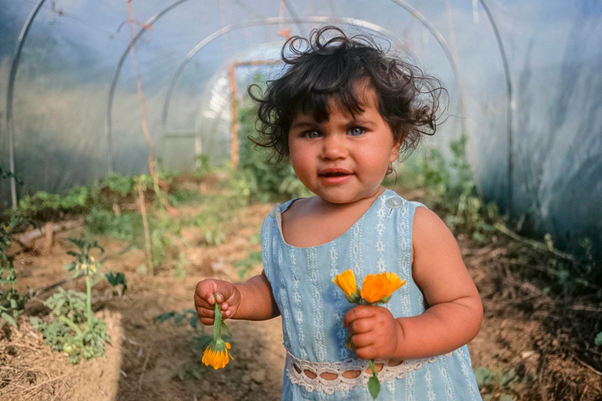
Letter to Future Landworkers
LWA founding member and Campaigns Coordinator, Jyoti Fernandes, shares her message to future landworkers in our new book “With the Land | Reflections on Landwork and Ten Years of the Landworkers’ Alliance“
It is a bright and frozen morning. Our young calf is lying in the sun, the birds are pecking at old seed heads through the ice, we have temporarily found a solution to the burst pipes, and I’ve just finished peeling carrots and potatoes, uncovered from storage and held plump in their own soil, to put in a stew on the woodstove. It is finally quiet and I have a few moments to think about you, future land workers, and share a few lessons I have learned.
I started this journey, working the land, because of my children. I was pregnant with my firstborn at the peak of youth, when ideals and energy are at their brightest. I had spent time with land-based indigenous communities, watching how they raised their children alongside their daily work; teaching them about how food grows and animals are raised, how the insects and birds, weather and creatures interact. How to gather wild plants, chop wood and preserve harvests. How to cook. How to warm themselves and learn the language of the landscape around them. I wanted my children to learn these things. So, my husband and I decided to become land workers, travelling from farm to farm to learn the skills and eventually falling in love with our own patch of land.
It has been a hard journey, as farming skills were not passed to us as children. We have had to relearn our skills from old farmers and books and experience as many of you will also have to do. There has been so much joy as we embed ourselves into the intricate web of nature and community. As we gained the skills to nurture orchards bursting with fruits and nuts, to breed flocks where multiple generations of sheep and cows often stand contently licking each other, to fill the larder with tomato passata over winter. Often the most satisfying moment of the year is when the freshly pressed apple juice is stacked into the apple juice shed, with the heat from the pasteuriser steaming off into the cool autumn air…
These moments of abundance sit alongside moments of despair. We have lost livestock and crops, grown harvests that we couldn’t sell, and fought the authorities to stay on our land. Even now, after over 20 years of farming, the dairy cow who had become my daughter’s favourite during the Covid-19 lockdown was lost to complications after birthing. I could see my daughters using skills they learned from their years on the farm to nurture the poorly cow, but it didn’t work out. We were sad and deflated, yet, through land work we have learned that you must pick yourself up, and that somehow death is a part of the cycle as much as the life of our new fluffy calf.
Lean into the fact that setbacks sit alongside victories, and from each you will learn. This understanding has become ingrained, as much as hope for the future persistently sits alongside fear in my heart. Coming to peace with this feeling builds resilience. I have often thought that every peasant in the world must feel this way.
Years ago, to find that shared understanding, I sought out a network of land workers. I wanted to be a part of a community building something larger than ourselves, so that all those heartbreaks were collectively held and their solutions our common cause. Yet, I have also found that the politics of people – in communities, in relationships – is often the hardest to negotiate as we find our way back to the land. I built the strength to deal with this as I learned; as each part of nature operates in its own unique way, so do people. If we embrace and build on that diversity, we can build collective strength.
At the first gathering of La Via Campesina (an international farmers organisation which coordinates peasant organisations founded in 1993) that I attended in Indonesia, I sat alongside hundreds of representatives of 200 million peasants, as they welcomed the Landworkers’ Alliance into the most diverse and complex, yet grounded, alliance of human beings I had ever encountered. All the feelings I had felt inside myself were channelled into concrete plans for resistance and building that world. I learned that there are many things we cannot do on our own, but when we do them together, we create magic.
Our movement will do all it can to build a strong foundation of knowledge and power for you to draw from. You will need it. The future world you will be working in will be chaotic and volatile. You will face extreme droughts and frozen spells and rain for weeks on end. There may well be economic collapse, hunger, and extinction on a mass scale.
There is a line in the Land Manifesto from which I have drawn inspiration for my work over these many years. It says that ‘when capitalism falls and the stars and stripes fade in the West, the land will remain’.
Truly, your work on the land will be the most important work there is. To keep the knowledge of the seeds and breeds in living, working memory as our grains of survival. The patterns you recreate will be ones that will see us through. The webs of relationships will be what we use to rise from the ashes.
My daughters, along with many others, created the land workers youth group called FLAME. They’ve become the flame that warms my heart as I see these young people working together, respectfully and compassionately. I know that we will have the opportunity to rebuild a better system in a design so much better than before. We have the foresight now to bring back nature as part of a just and equitable society, in a new pattern, based on the old knowledge and skills of our ancestors but more exciting than ever before in history.
Future land workers —you are our legacy and our hope.
We, as land elders, will collectively hold you to go forth to restore our land with grace, agility, wisdom, and above all, love.
-
Reclaiming knowledge of the sea – Norway Diaries by Richard Andersen
“Good luck to the farmer! Good luck to the one who owns this place, the one who works it, the faithful, the virtuous! I can love them, I can revere them, I can envy them. But I have wasted half my life trying to live their life. I wanted to be something that I was not. I even wanted to be a poet and a middleclass person at the same time. I wanted to be an artist and a man of fantasy, but I also wanted to be a good man, a man at home. It all went on for a long time, till I knew that one cannot be both and have both, that I am a nomad and not a farmer, a man who searches and not a man who keeps.”
Herman Hesse
…
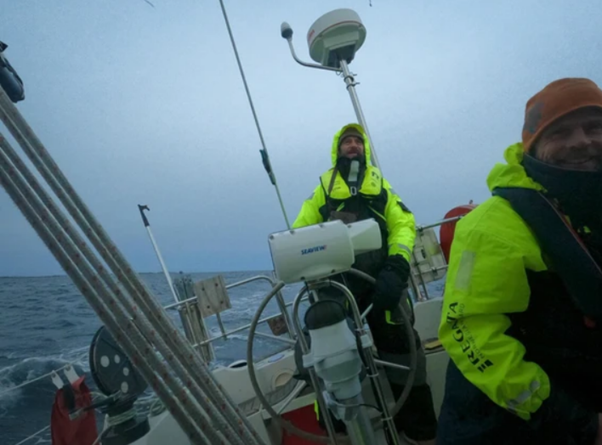
The wind is approaching gale force and the waves are growing in size and menace. We’re 20 nautical miles from Brønnøysund, heading for Rørvik on a plotted course outside the protective archipelago hugging the Norwegian coastline. After a phone call to my sailing mentor we’ve decided to try our hands at offshore sailing in more challenging conditions than our normal conservative sailing routine would allow. But the promised north-easterlies have backed north-westerly and are now hitting us square on the beam without the option of altering our course due to the skerries and shallows off our port side. This is why sailors fear a lee shore in bad weather.
It’s late November and myself, Thomas from Norway and Seb from Poland, and later Al from Manchester, are sailing Cecilia from Lofoten, on the northern tip of the Caledonian mountain range just inside the arctic circle, to my hometown Stavanger. It’s a long, cold and mostly dark trip of 900 nautical miles along the Norwegian coast at the onset of winter, but when the lights are on they are dazzling. Snow capped mountains glide past and most of the time the archipelago protects us from the swell of the Norwegian Sea.
For now we have no option but to stay on the current heading until clear waters allow us to head south and get the wind and waves on our stern. Thomas is on the helm, steady as a rock, his years of army training, wilderness expeditions and organic farming giving him the calm and collected pin sharp focus needed to read the waves and bear away every time one of them threatens to break on top of us. The finely wound nylon cordage around the steering wheel is in tatters from his constant frenzied helming to keep us from being swallowed by cascading water.
Luckily the sea is lit up by the comforting light of a near-full moon. The foam of each breaking wave shimmers magically as it tumbles, and the mast and deeply furled genoa cast a pleasant silhouette against a million little stars. We’re not quite ready for celestial navigation yet, but picking out a star in the sky and keeping it ‘just so’ to port or starboard of the mast is still a fun way to keep a true course, provided you change your star every now and then. Mixed in with the shear dread of how much worse this can possibly get and how much of a beating the boat can take is an unbounded childish glee at being so intensely alive.
Earlier that night we were treated to a celestial display of aurora borealis, along with something I never even knew existed, a ‘moonbow’, or a rainbow caused by the moon rather than the sun. It’s an eerie rainbow cast in a monotone greyscale, but a long exposure photograph revealed it’s colours in a shaky haze. Sailing in high northern latitudes this close to winter solstice is mostly a journey through shadow lands. Coastal mountain ranges hover alongside the boat like black rifts in a dark sky. Other boats appear and disappear like fireflies and not a single other sailboat to be seen, funnily enough
I bought the boat unseen two summers ago on the Norwegian equivalent of Gumtree and enlisted a crew of adventurous souls to bring her, and us, safely down south. This month-long journey has so far proved as much a rite of passage as anything I’ve done before in my life.
The idea of acquiring a sailboat arose as far from the sea as it is possible to get in Norway, in the eastern forests where ‘my’ winter cabin sits nestled among the trees and the moose. I found myself there when lock-down happened and decided to stay for a while longer. A year-and-a-day turned into two and a half years and deepened my relationship with the lands and the crafts and the people. A new logical family formed around me. It became apparent that I didn’t want to give up on either my extended family of friends in the UK or my fledgling little tribe in the north, as well as my newfound closeness to my biological family. Driving back and forth was out of the question. Sailing was just kind of the logical thing to do.
I’m not a very experienced sailor. I have a competent crew qualification from a gaff rigged wooden cutter in Falmouth some years back, and have managed to sail between Stavanger and Orkney on a couple of occasions, pretty much unscathed except for falling overboard in a gale once. Both my granddads were sailors in Norway’s merchant navy. Not on sailboats mind, but close enough for the allure of wind and salt water to feel close at hand. Not to mention the illustrious seafaring traditions of a native land that is pretty much all coast.
Sailing in these kinds of conditions is definitely what you would call type 2 fun. The kind of adventure that makes you cry in the middle of it and wonder why the fuck you ever put yourself in this position in the first place. But when you come out the other side it’s like something’s changed inside you. You’re the same but not the same. Smaller worries are seen with a new perspective and getting up from a fall and carrying on regardless becomes an ingrained habit.
And falling over is definitely the new normal. Shit happens. Regularly. Stuff continuously breaks on a sailboat. All. The. Time. It’s not like the occasional repairs of a motorhome that chugs along on country lanes and if the breaks squeal you make a mental note of looking at them soon-ish. There is no ‘I’ll get to that later’ when your life literally depends on it working. So you repair. And replace. And repair. And replace. Until one day you sell the boat with a relieved sigh, or find yourself so in love with the freedom of open waters that you never look back. But I haven’t gotten past the honeymoon period just yet.
For now I want to try out being a seasonal nomad between my two homelands. Sailing is just another ancestral skill I’m determined to learn whilst I still have the health to do so. And as with any other craft I learn, the motivation is just as strong for passing it on as for picking it up. Part of the plan is therefore to take people along for the ride. Back and forth across the north sea like the old ways from the old days, but more trade, less marauding hordes.
Getting the boat to Stavanger was just the start. After leaving Cecilia tucked up in a sheltered fjord with my dad and brother checking in on her from time to time I made it across the mountains to my winter lair and Norwegian tribe near Rena. I made it there for solstice and hit the cabin floor with a thud determined to go into hibernation for a good long stretch. Seeing my friends again was a delight. New year’s eve was duly celebrated with a monster bonfire and monster rig. Lucy popped by to a continued wow at the virgin experience of a northern winter at its sparkling best, and after they left 70 reindeer skins turned up at the door, ready to be processed and exported as sail cargo. Another stint teaching grindbygg timber framing at Hjerleid capped my visit, and suddenly another shockingly mild winter (rarely down to -20C) was ebbing and I had the curious thought of a boat waiting for me in a fjord on the other side of the country.
A month of prepping lay ahead once I arrived in Stavanger in April. The starboard spreader had come loose in a crash-gybe and needed seeing to. Turns out both shrouds needed replacing too. The genoa was patched up with sticky back sailcloth and stitched by a local sailmaker, a wizened old salt from the USofA washed up on these shores many moons ago. Leaks were found and sealed, light fittings replaced, play in the steering tightened, railings made taut, engine cooling system dismantled and refitted, filters changed, electrical faults chased, and so on.
Sam and Jamie arrived for the feast of repairs before crewing with me to Scotland, and friends and family dropped in to say hi down at the harbour. It’s the first time in over 20 years that I’ve had my own place in Norway where I can receive guests and it put an entirely new spin on coming ‘home’ to visit. I am no longer just visiting, but can feel part of the furniture with my own space to retreat to.
From the eastern tribe and western family in Norway we sailed to Orkney via Utsira, after a very bouncy journey in a boat heavily laden with a significant amount of axes and a few more kilos of old steel tools. We were violently sick for most of the crossing due to the combined factors of an overweight boat, crossing waves and stale water. The latter was due to my schoolboy error of neglecting to change the water in the tanks which had sat there all winter. I literally poisoned my crew on Cecilia’s very first commute. Please forgive me Jamie and Sam!! Nonetheless, the day was saved as we arrived to the delightful tunes and heart opening hospitality of Craig and Jane on Tingwall harbour. The tribe of the Egilsay solstice gathering felt like a tantalising memory soon to be made real.
After a couple of days recovery and fattening up, Jamie left us to get back to work and myself and Sam headed south past the Pentland Firth on a 22 hour gruelling sail into the wind to arrive in Wick at 4am the next morning with a limp engine and a very tired looking harbour master there to guide us in as we sailed into the harbour.
After Wick we were treated to a stiff offshore breeze with hardly any waves and wooshed across the Moray Firth to squeals of delight. Deciding to go via the Caledonian canal made me reach out the Scottish Anarcho Folk Festival and got me in touch with Jim at Thistleflat. Cecilia was happy to stay in Lossiemouth for a few days and Jim beckoned us to follow him to a tucked-away glen where his own Scottish tribe put on a wee rave. Dirty basslines and green Scottish valleys provided a welcome distraction from the mini rig on Cecilia and the endless blue of the sea.
The canal itself was largely uneventful. Full of middle class men and retired couples in shiny plastic boats. None of them got their sails out for the duration of the canal, although me and Sam doggedly beat against the winds the entire length of Loch Ness and Loch Lochy. But the real magic came upon us in the middle lake, Loch Oich. Not more than perhaps 100m across in places, and billowing trees hanging over each bank, this really gave us the eerie sensation of real world magic it is to sail straight through the Scottish highlands, with mountain peaks looming behind steep valleys. It was also here I felt the keenest sense of the displaced native inhabitants, who were forced to flee their lands in the Clearances, and generations later taken on as indentured labourers to dig the the canal with spades to the whims of Victorian aristocrats.
Jen and Cecilia joined us in Fort William and we had dream winds all the way to Wales. Anchoring in sheltered coves along the way, a nifty hand-brake turn to moor alongside a Russian shrimp trawler, uneventfully passing the dreaded Mull of Kintyre and eating the worlds most bland chinese take away in a pub in Glenarm in Northern Ireland. A slightly more tasty fish and chips was had in Holyhead but leaving port we were treated to the most intense wind-over-tide conditions I’ve ever experienced and provided the latest in a string of steep learning curves. Four metre waves steeper than a skate park half-pipe grew out of nowhere and lasted for a good hour until we cleared Anglesay and could turn with the tide and head south. Sam got airborne trying to go to bed and I sat with clenched knuckles holding on to the railing behind the steering wheel, praying to Njord that the engine would hold it together. It did, and we sailed on Bardsay with a following tide and wind a-beam.
The next day, after guerrilla mooring on a lonely buoy outside Abersoch, we were treated to a homecoming stretch of azure waters, gentle winds and no waves, with Jen dangling from the spinnaker halyard and myself in tow in the dinghy behind. We approached Barmouth harbour with the entire Snowdonia mountain range bisecting the horizon. Coming home from home never felt so real.
The expectation is that one day I’ll find the uprootedness of sailing between two families too much and a desire to choose a place to settle will come naturally. But before then I might need to get a bigger boat. I want more space for tat, tools and reindeer skins. And humans. Above all it’s an experiment in new-old ways of being in the world. Because change is happening and we need to change with it.
Our environment is crashing in slow motion. So slow that most people haven’t noticed yet. Commuting between Norway and Wales by sail is one of many ways of getting people’s attention and start conversations around climate change and resilience. If we’re going to weather the coming storm we need to think outside the box and dust off some of the old boxes too. We need the farmers and the hunters, the weavers and the tanners, the builders of bridges and the builders of community. We need the theorists and pragmatists, the neuro-typical and the neuro-diverse, the boys and the girls and the non-binosaurs.
Most of all, we need to experiment with ‘other’ ways of being, old others and new others, because that’s how evolution happens. When the pressures on an environment grow past the inhabitants’ capacity for absorbing those, nature starts experimenting. Epigenetics teaches us that evolution is not a series of blind shots in the dark, but a process of switching genes on and off to meet new challenges, a process some would even claim has a conscious element to it.
And at the same time as acknowledging the looming challenges it’s also important to celebrate the joy of life in all it’s guises. One thing that is becoming apparent with this sailing lark is the connections it forges. Through my relationship with Cecilia I have had the pleasure of dropping in on string-of-pearls of friends and family and tribe stretching from the easternmost reaches of Norway to the western edge of Britain, spanning a considerable chunk of the Norse and Celtic stomping grounds. New friendships have been forged and old ones reaffirmed. I have danced my socks off and I have feared for my life. And I have so far lived to tell the tale. Perhaps a little wiser but most definitely more alive.
Rich xxx
Barmouth, August, 2022